Etsy Selling
How to Write Etsy Listings That Rank and Convert in 2026
By Emma Blake, Etsy SEO Consultant · Updated 2026-03-31
Every Etsy listing you publish is doing three jobs at once: telling Etsy's search algorithm what you sell, convincing a scrolling buyer to click, and persuading that buyer to add to cart. Most sellers treat a listing like a form to fill out. The sellers pulling $10K+ months treat it like a conversion machine—and they tune every field for maximum output. This guide walks you through the exact process I use with my consulting clients to write listings that rank on page one and convert at 3–5 percent. Everything here is updated for the 2026 Etsy search algorithm, including changes to listing quality score weighting and the expanded role of shop-level signals.
Last updated March 2026
Affiliate Disclosure: This article contains affiliate links. We may earn a commission at no extra cost to you if you purchase through our links.
Table of Contents
- Understanding Etsy's 2026 Search Algorithm
- The Etsy Title Formula That Ranks on Page One
- Etsy Tags Strategy: Filling All 13 Slots the Right Way
- Description Templates That Convert Browsers to Buyers
- Photo Sequencing: The 10-Image Conversion Framework
- Pricing Psychology and Fee Math for Etsy Sellers
- Best Etsy Seller Tools for Listing Optimization
- Advanced Listing Optimization Tactics
- Listing Audit Checklist: Fix These Mistakes First
- FAQ: Etsy Listing Optimization
 Hero visual for this section
Understanding Etsy's 2026 Search Algorithm
 Comparison visual for Understanding Etsy's 2026 Search Algorithm
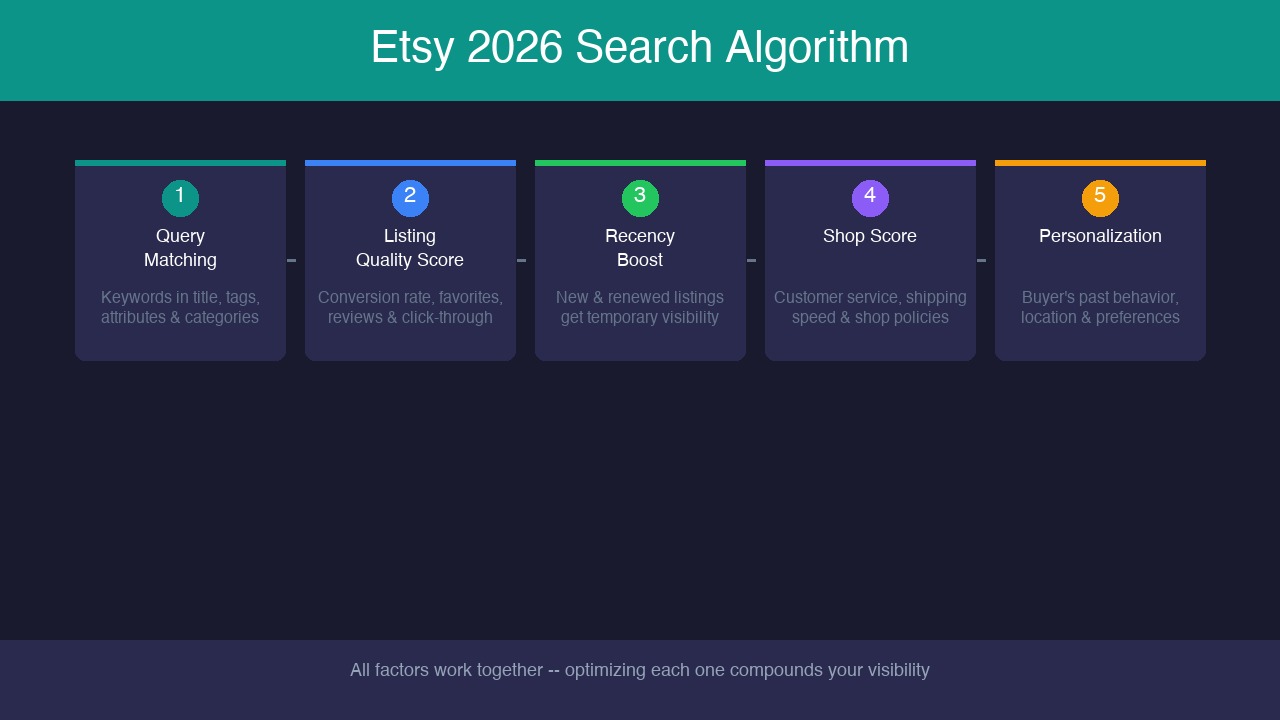
Before you write a single word of your listing, you need to understand what Etsy's search engine is actually looking for. Etsy's algorithm ranks listings using a combination of relevancy matching and listing quality scoring. In 2026, the system weighs several factors in this order of importance:
1. Query Matching (Relevancy)
Etsy compares the buyer's search query against your title, tags, categories, and attributes. The algorithm uses exact-match and broad-match logic. If a buyer searches "personalized dog collar leather," Etsy first looks for listings with that exact phrase in the title or tags, then broadens to listings containing those individual words.
The critical insight: Etsy combines your title and tags into one keyword pool. Words in your title do not need to be repeated in your tags. Every duplicated word is a wasted opportunity to target an additional search query.
2. Listing Quality Score
This is Etsy's internal metric based on how buyers interact with your listing. It factors in:
- Click-through rate (CTR): The percentage of people who see your listing in search and click. This is driven almost entirely by your hero photo and the first 40 characters of your title.
- Conversion rate: The percentage of visitors who buy. This is driven by your photos, description, price, reviews, and shipping speed.
- Favorites and cart adds: Signals of interest that don't result in immediate purchase.
A listing with a high quality score will outrank a listing with better keyword matching but poor engagement. This means writing a great listing is not just about SEO—it is about conversion optimization.
3. Recency
New and recently renewed listings get a short-term visibility boost. Etsy does this to test new listings against established ones. The boost typically lasts 24–72 hours and tapers off. This is why the first few days of a listing's life are so important—strong early performance compounds into long-term ranking.
4. Shop Score
Etsy factors in your overall shop health: average review rating, response time, on-time shipping rate, and whether you've completed your shop policies and About section. A shop with a 4.9 rating and fast shipping will rank higher than a 4.2 shop with identical listings.
5. Shopper Personalization
Etsy personalizes results based on each buyer's browsing and purchase history. You can't control this directly, but having well-categorized listings with accurate attributes ensures you show up for the right buyer segments.
Understanding these five layers means you can optimize with intention instead of guessing. Every section of this guide targets one or more of these ranking factors.
If you're still setting up your shop, start with our guide on how to start an Etsy shop in 2026 before optimizing individual listings.
The Etsy Title Formula That Ranks on Page One
 Infographic visual for The Etsy Title Formula That Ranks on Page One
Your title is the most important field in your entire listing. It determines which searches your product appears in, and the first 40 characters determine whether a buyer clicks or scrolls past.
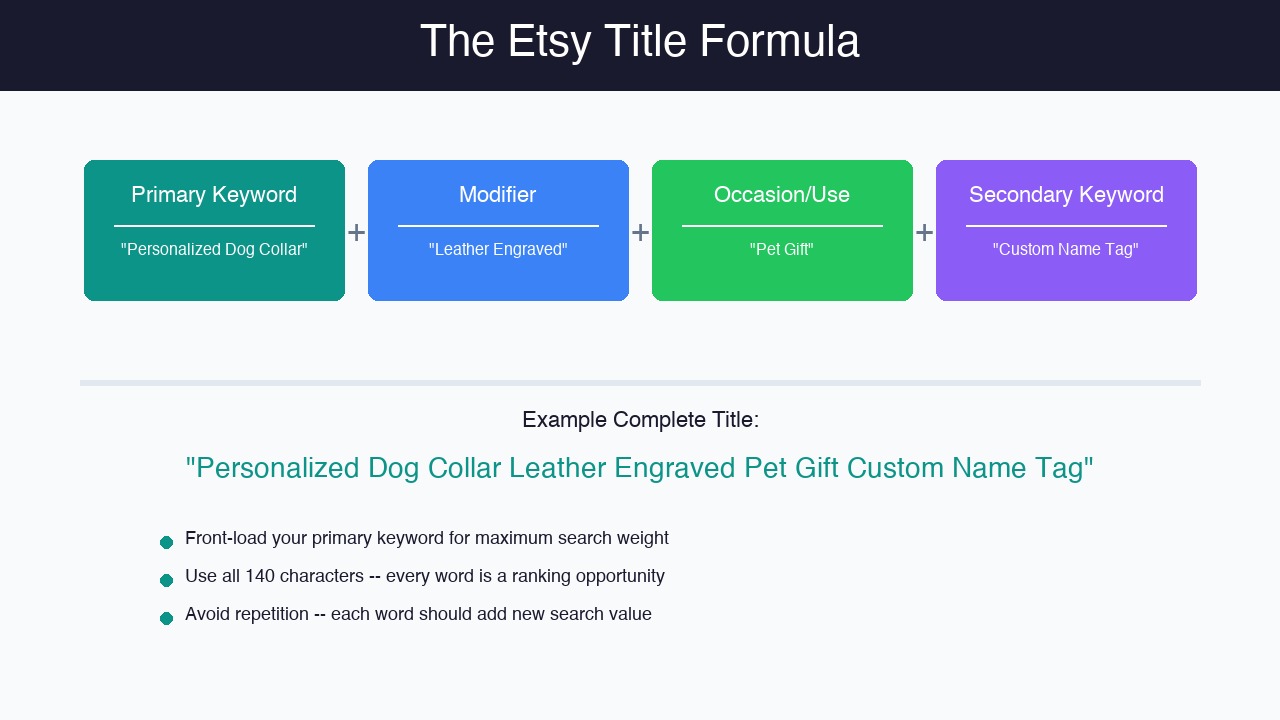
The Four-Part Title Formula
Every high-ranking Etsy title follows this structure:
Primary Keyword + Descriptive Modifier + Use Case / Occasion + Secondary Keyword
Here's what each part does:
- Primary Keyword (characters 1–40): The exact phrase buyers type into Etsy search. This MUST be in the first 40 characters because that's what displays in search results on desktop and mobile. Etsy's algorithm gives more weight to words positioned earlier in the title.
- Descriptive Modifier: Material, color, size, or style details that help Etsy match you to more specific queries. "Custom leather" is a modifier. "Handmade ceramic" is a modifier.
- Use Case / Occasion: High-intent terms like "birthday gift," "wedding favor," "housewarming present." Buyers searching with occasion terms are ready to buy—they have a deadline.
- Secondary Keyword: A related search phrase that expands your reach. If your primary keyword is "personalized dog collar," your secondary might be "custom pet ID tag" or "engraved puppy collar."
Title Examples That Work
| Weak Title | Optimized Title |
|---|---|
| Pretty Earrings | Gold Huggie Hoop Earrings, Small Gold Hoops for Everyday, Minimalist Jewelry Gift for Her |
| Baby Blanket | Personalized Baby Blanket with Name, Custom Knit Newborn Blanket, Baby Shower Gift |
| Digital Planner | 2026 Digital Planner for iPad GoodNotes, Weekly Monthly Budget Planner, ADHD Planner Template |
| Candle | Soy Wax Candle Lavender Vanilla, Hand-Poured Aromatherapy Candle, Self Care Gift for Women |
| Wood Sign | Custom Family Name Sign, Personalized Last Name Wood Sign, Rustic Farmhouse Wall Decor |
Title Rules for 2026
- Use all 140 characters. Every unused character is a search query you're not targeting.
- Front-load the primary keyword. Characters 1–40 appear in search result thumbnails. Put your best keyword phrase there.
- Separate phrases with commas. Etsy treats comma-separated segments as distinct keyword groups, letting you target multiple queries from one title.
- Never repeat words. "Personalized" in segment one and again in segment three wastes characters. Etsy counts each unique word once.
- Skip vanity adjectives. Words like "beautiful," "amazing," "stunning" consume characters and add zero search value. Buyers decide from photos, not adjectives.
- Include one occasion term. "Mother's Day gift," "Christmas stocking stuffer," "bridesmaid proposal gift"—occasion terms capture buyers with high purchase intent and tight deadlines.
- Don't stuff keywords unnaturally. Etsy's algorithm can detect keyword spam. A title should be readable as a coherent product description, not a random word salad.
Finding Your Primary Keyword
Open Etsy in an incognito window and start typing what a buyer would search. Etsy's autocomplete suggestions are pulled from actual search volume data—they tell you exactly what people are looking for.
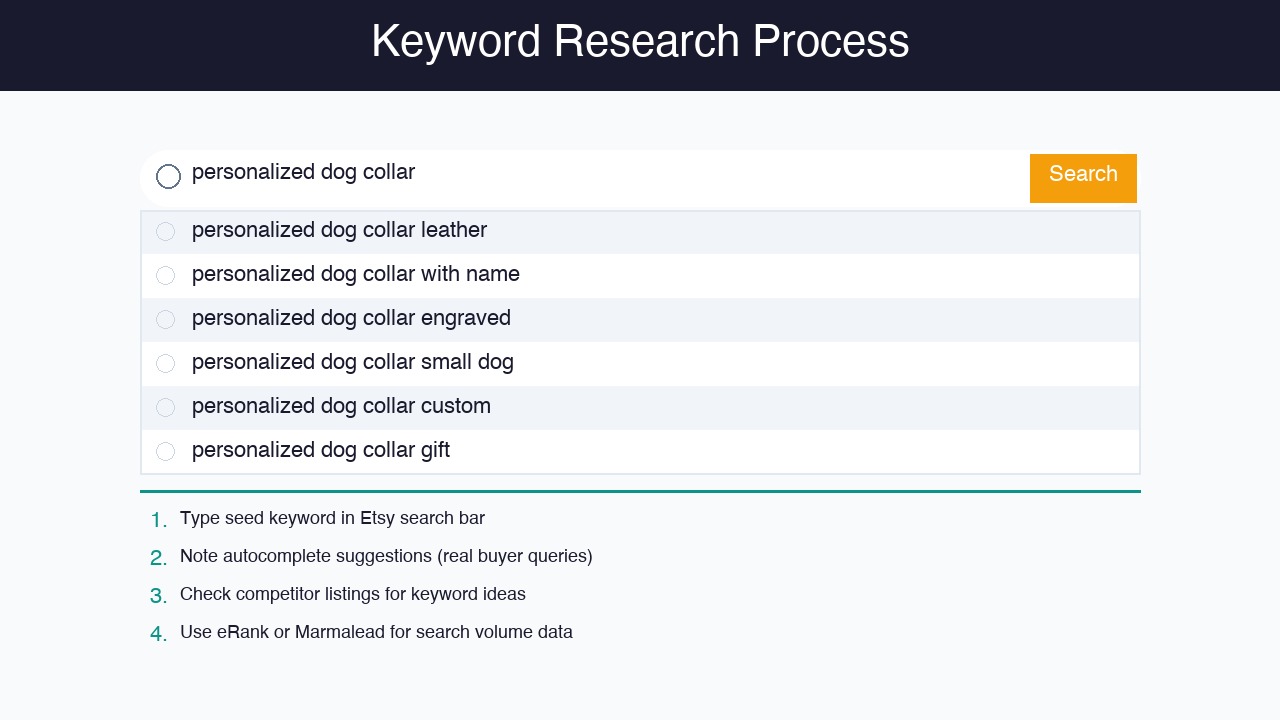
Write down the top 10 autocomplete suggestions for your product type. These are your primary keyword candidates. Pick the phrase that most precisely describes your product and build your title around it.
Pro tip: Go to your Etsy dashboard → Stats → Search Terms to see what real buyers are already typing to find your listings. Double down on terms that bring clicks, and replace terms that bring impressions but no clicks—those are keyword mismatches.
For deeper keyword research strategies, see our best Etsy SEO tools guide.
Etsy Tags Strategy: Filling All 13 Slots the Right Way
 Setup visual for Etsy Tags Strategy: Filling All 13 Slots the Right Way
Tags are the second strongest SEO lever after your title. Etsy gives you 13 tag slots, each up to 20 characters. Most sellers use 5–7 generic single-word tags and leave the rest empty. That is like paying rent on a ten-room apartment and only furnishing three rooms.
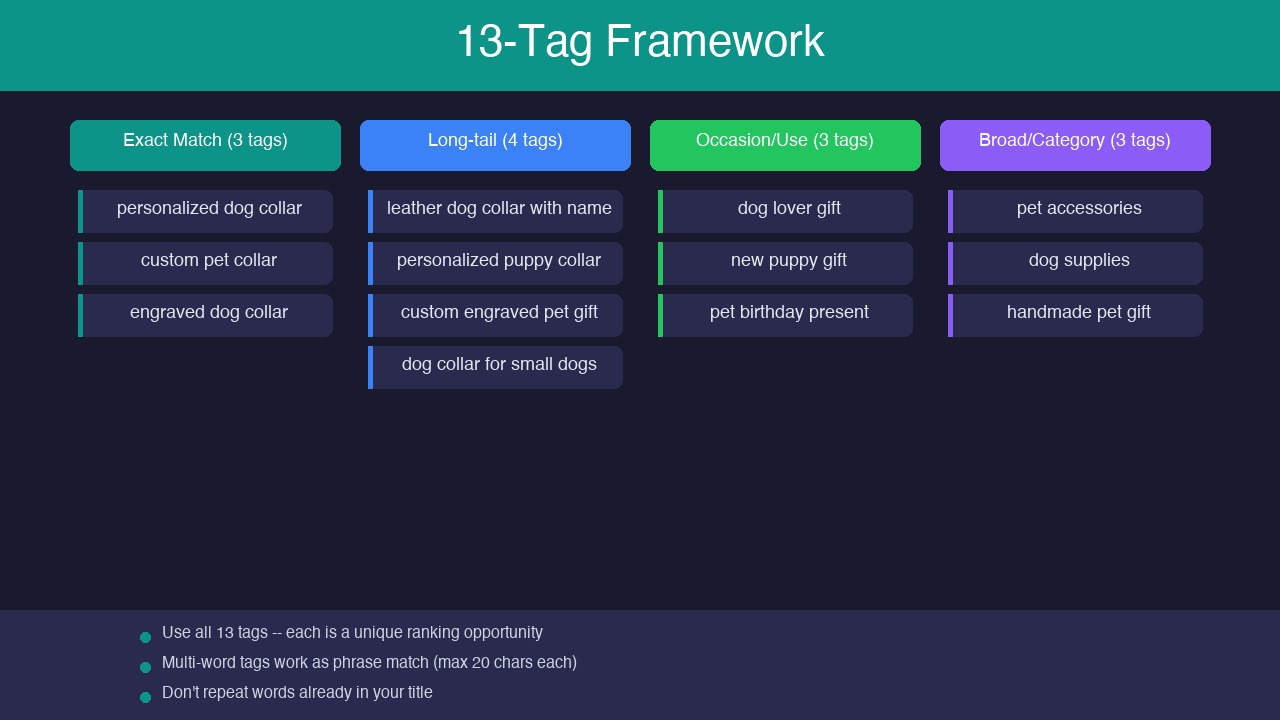
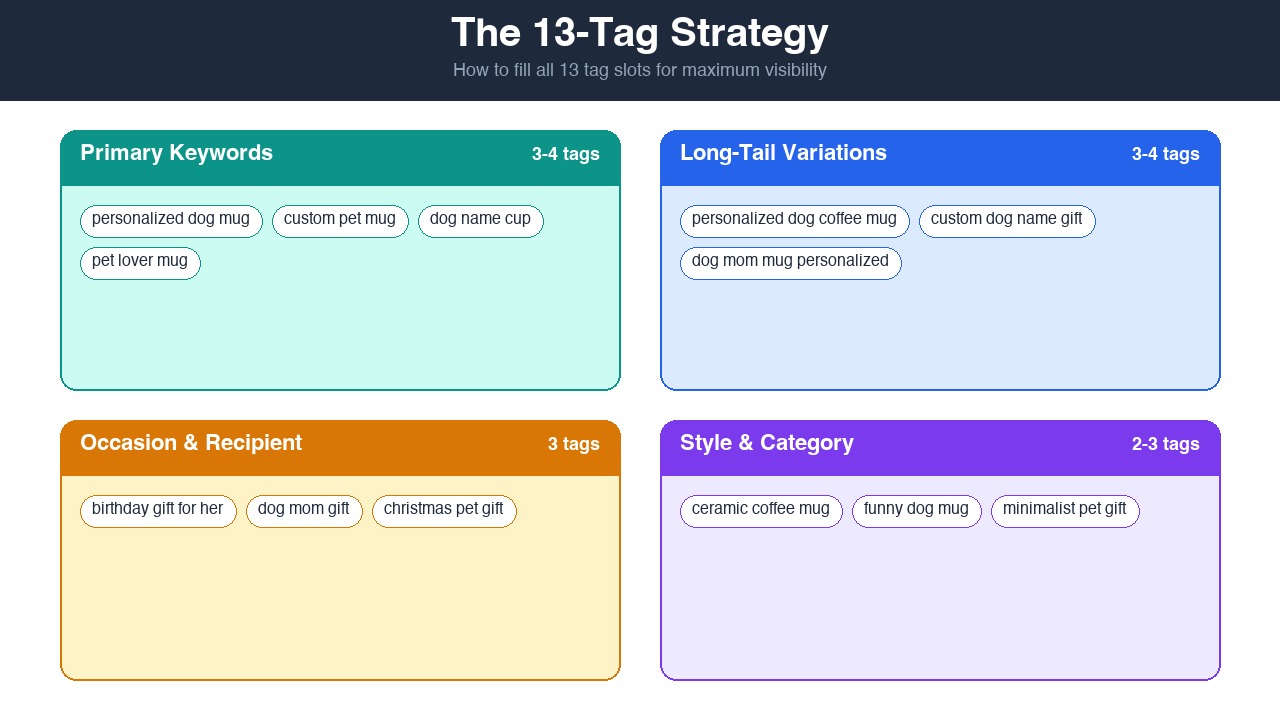
The Four-Category Tag Framework
Divide your 13 tags into four strategic buckets:
Primary Keyword Tags (3–4 tags)
Multi-word phrases that match common buyer searches. These should complement—not duplicate—your title keywords. If your title includes "personalized dog collar," your primary tags might be "custom pet collar," "engraved dog tag," and "leather dog collar."
Long-Tail Variation Tags (3–4 tags)
More specific versions of your keywords. Long-tail terms have lower search volume but higher conversion rates because the buyer knows exactly what they want. Examples: "small dog collar pink," "puppy name collar," "adjustable pet collar."
Occasion and Recipient Tags (3 tags)
Who is this product for, and when will they buy it? "Gift for dog mom," "new puppy gift," "pet lover birthday." These tags capture seasonal and event-driven traffic from buyers who are ready to purchase.
Style and Category Tags (2–3 tags)
Aesthetic and material descriptors that help Etsy's browse and filter features surface your listing. "Boho pet accessories," "rustic leather goods," "handmade dog gear."
Tag Rules That Most Sellers Break
- Use multi-word phrases. "Dog collar" is better than "collar." "Personalized pet gift" is better than "personalized." Phrases have less competition and higher relevance.
- Never duplicate title words in tags. Etsy already indexes your title. Repeating "personalized" in both your title and tags adds zero search value.
- Use all 13 slots. Always. No exceptions. Five empty tag slots mean five categories of buyers who will never see your product.
- Rotate underperforming tags monthly. Check Etsy Stats → Search Terms. If a tag hasn't driven a single view in 30 days, replace it with a new phrase.
- Include regional spelling variations if relevant. "Jewelry" vs. "jewellery," "favor" vs. "favour"—if your audience spans the US and UK, tag for both.
Tag Research Workflow
- Search your product type on Etsy and open the top 5 bestselling listings
- Use a tool like eRank or Marmalead to view their tags (you can't see tags natively on Etsy)
- Note which tags appear across multiple top sellers—those are proven performers
- Check Etsy autocomplete for additional phrase ideas
- Cross-reference with Google Trends to identify rising search terms
- Build your 13 tags using the four-category framework above
- Set a monthly calendar reminder to audit and rotate underperformers
Description Templates That Convert Browsers to Buyers
 Detail visual for Description Templates That Convert Browsers to Buyers
Etsy has confirmed that descriptions do not directly affect search ranking. But they massively affect conversion rate—and conversion rate feeds back into your listing quality score, which does affect ranking. A buyer who clicks and finds a thin, confusing, or missing description will leave. A buyer who finds a clear, benefit-driven, objection-killing description will buy.
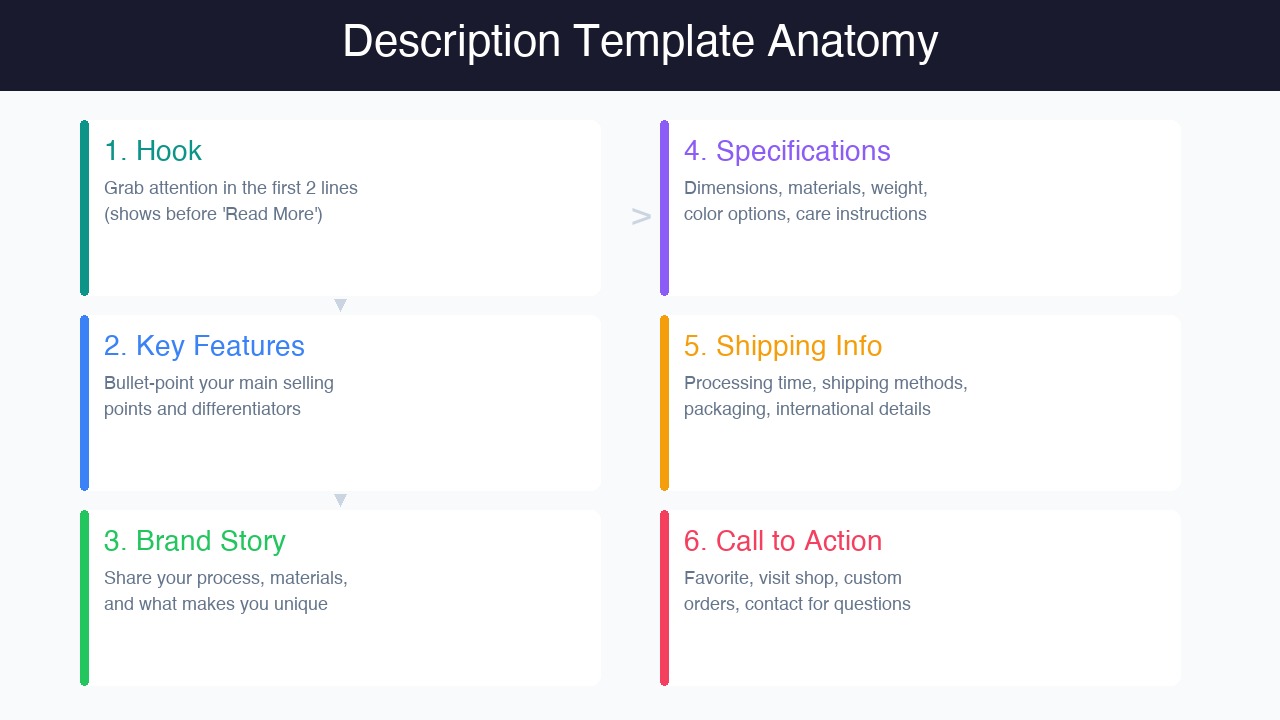
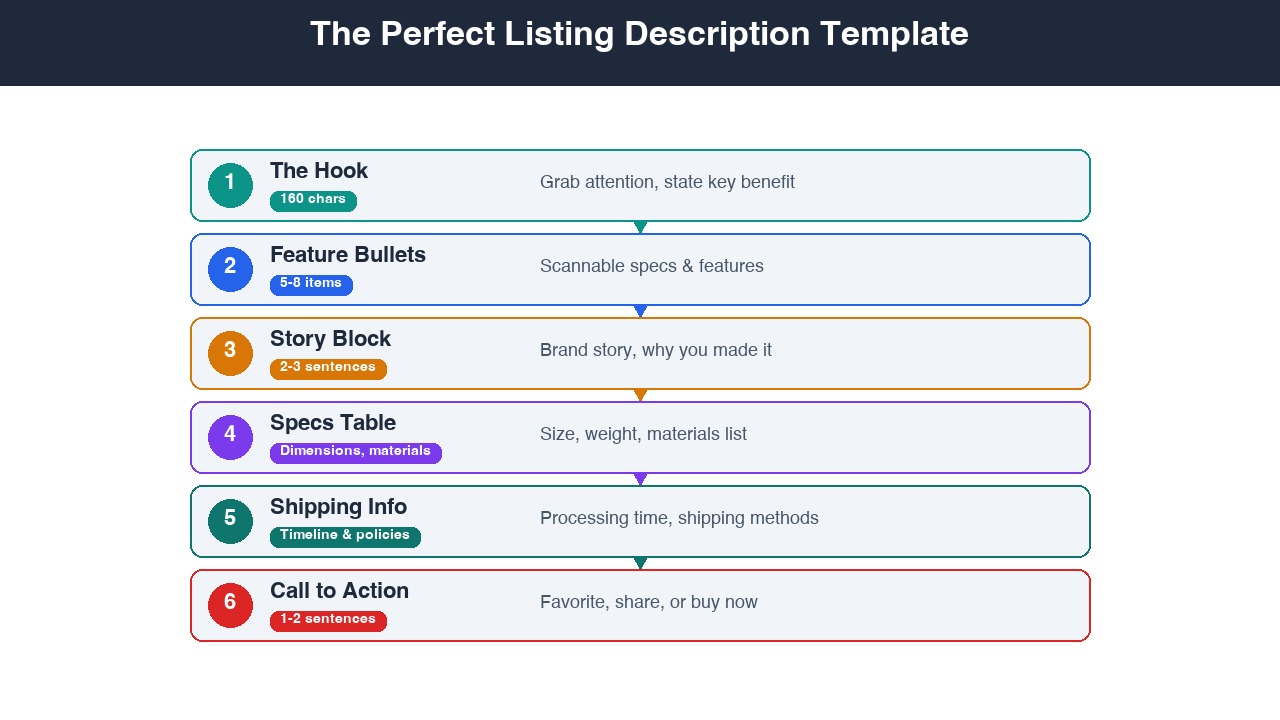
The Six-Section Description Template
This template works across every Etsy category because it answers every question a buyer has in the order they think of them.
Section 1: The Hook (First 160 Characters)
The first 160 characters appear in Google search snippets and Etsy's mobile preview. Lead with the most compelling benefit or the strongest unique selling point. Do not start with "Thanks for visiting my shop" or "Welcome to [Shop Name]"—those waste your most valuable real estate.
Example: "The personalized dog collar every pet parent asks about. Hand-stitched full-grain leather with your dog's name and phone number laser-engraved—built to last through mud, rain, and zoomies."
Section 2: Feature Bullets (5–8 Bullets)
Switch to scannable bullet points. Online buyers skim—they do not read paragraphs. Each bullet should answer a specific question:
- Material and quality level (e.g., "Full-grain vegetable-tanned leather, 1.5mm thick")
- Exact dimensions and sizing (e.g., "Small: 9–12 inch neck, Medium: 12–16 inch, Large: 16–20 inch")
- Customization options (e.g., "Choose from 8 thread colors and 3 hardware finishes")
- Care instructions (e.g., "Wipe clean with damp cloth; condition leather every 6 months")
- What's included (e.g., "Includes collar + matching leash ring + branded cotton pouch")
Section 3: The Story Block (2–3 Short Paragraphs)
This is where you sell the experience, not just the object. Why should someone buy this from you instead of from the other 500 shops selling similar products? Talk about craftsmanship, your process, your materials sourcing, or the problem you're solving.
Example: "I started making dog collars after my rescue pup Maple chewed through three store-bought collars in a month. I wanted something that could handle real life—not just look good on Instagram. Every collar in this shop is hand-cut and hand-stitched by me in my Portland workshop, using leather sourced from a family tannery in Tennessee. I've shipped over 8,000 collars to happy dogs (and their humans) across 14 countries."
Section 4: Sizing and Specs Table
If your product comes in sizes, include a simple reference guide. Reducing sizing uncertainty reduces returns and buyer anxiety—both of which improve conversions.
Section 5: Shipping and Processing
Answer the three questions that hit your inbox most:
- How long until it ships? ("Ships within 3–5 business days after order confirmation")
- How long is delivery? ("US delivery: 5–7 business days via USPS First Class")
- Do you ship internationally? ("International shipping available—delivery typically 10–20 business days")
Section 6: Call to Action
Close with a soft, friendly CTA. Don't be pushy—guide the next step:
Example: "Questions about sizing or customization? Message me anytime—I respond within a few hours. Tap 'Add to Cart' and enter your dog's name and phone number in the personalization box at checkout."
Description Length Guidelines
- Under 200 words: Feels thin and unprofessional. Buyers assume you're a low-effort shop.
- 300–600 words: The sweet spot for most products. Detailed enough to answer questions, short enough to hold attention.
- Over 800 words: Only appropriate for complex or high-ticket items (custom furniture, made-to-order clothing with extensive sizing).
Building strong daily habits for Etsy shop growth alongside your listing work is what separates part-time hobbyists from full-time sellers.
Photo Sequencing: The 10-Image Conversion Framework
 Lifestyle visual for Photo Sequencing: The 10-Image Conversion Framework
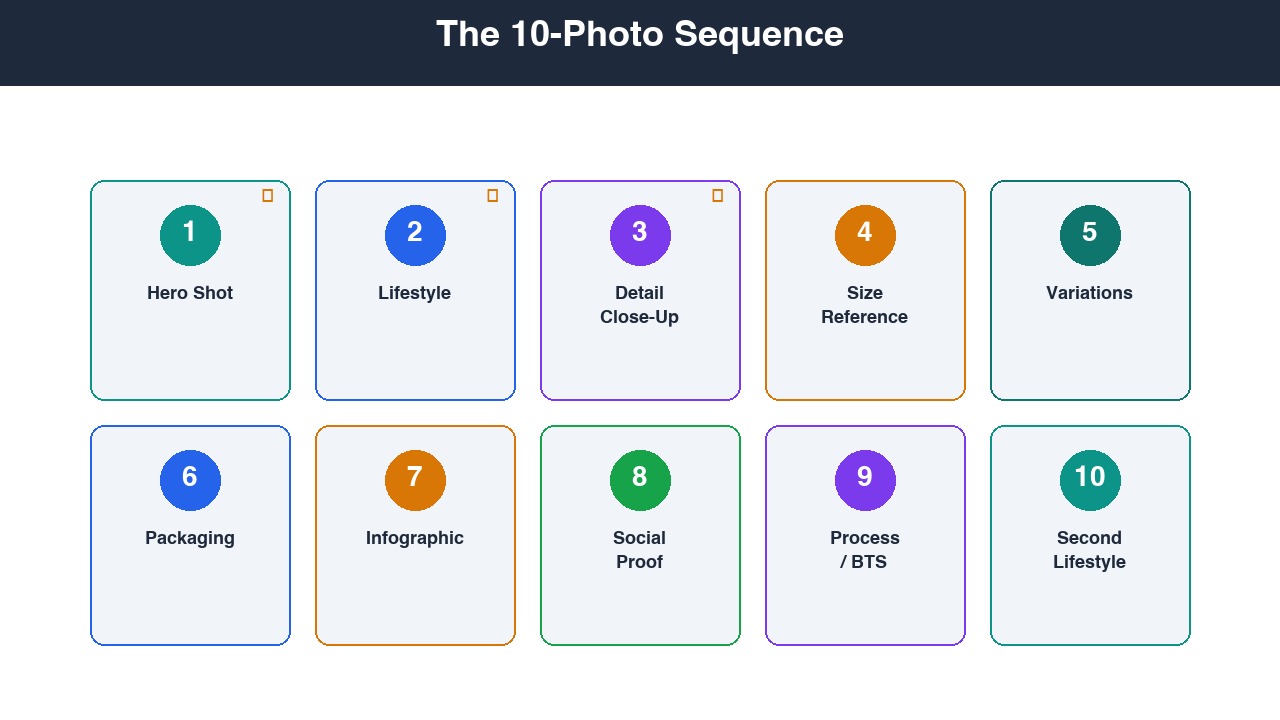
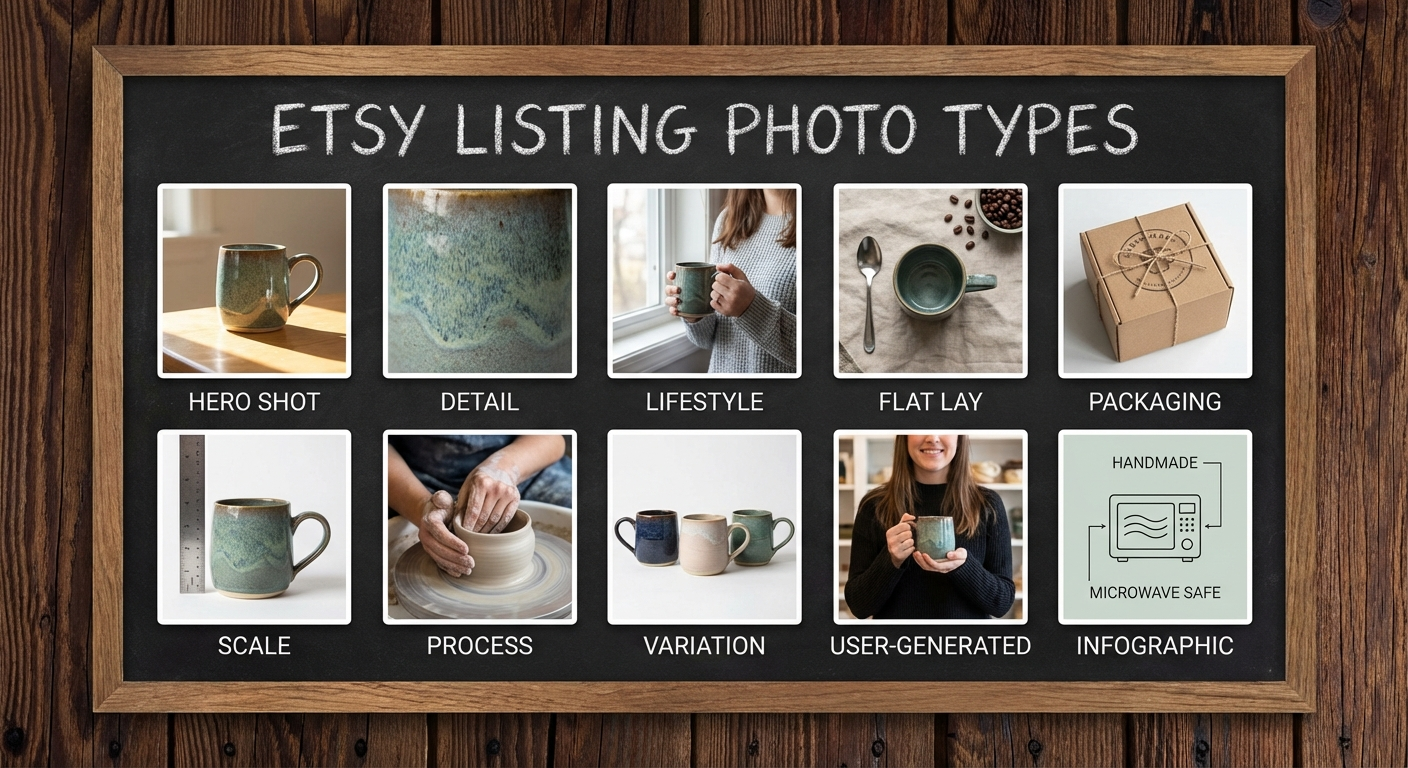
Etsy gives you 10 photo slots. Use all 10. Internal data from sellers I've consulted shows that listings with 7+ photos convert at 1.8–2.2 times the rate of listings with 3 or fewer photos. But volume alone is not enough—the order and purpose of each photo matters.
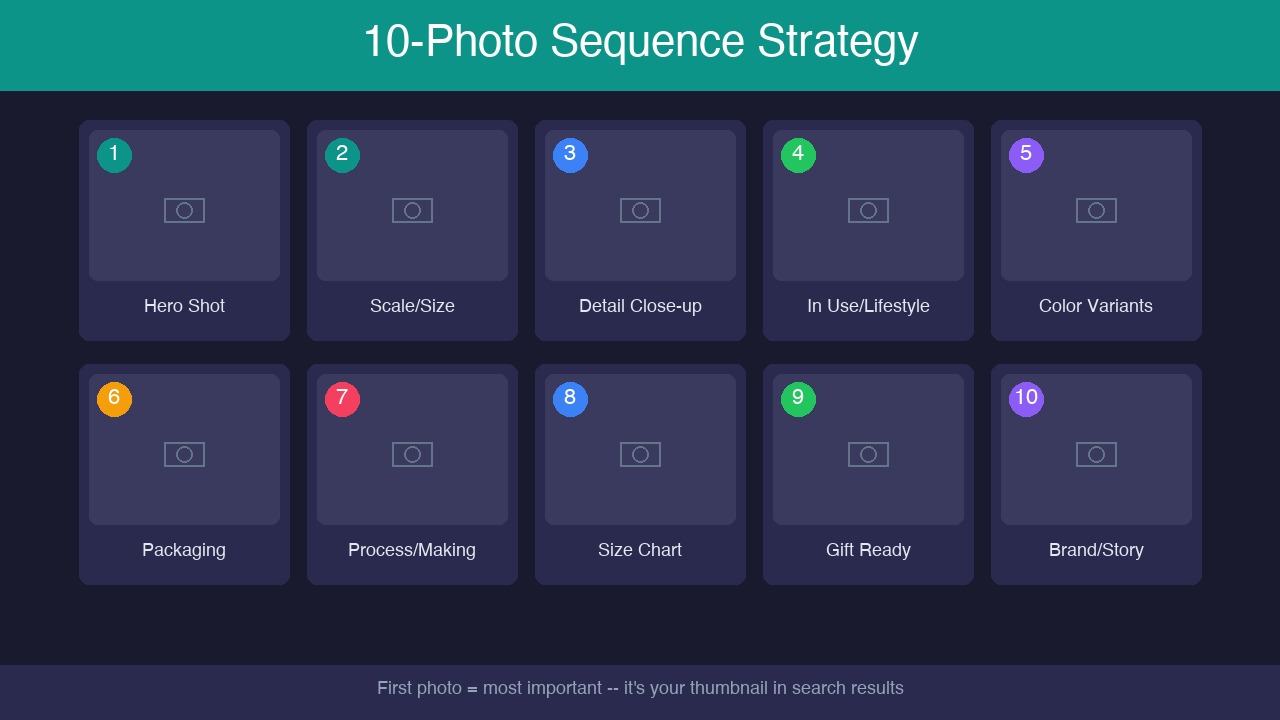
The 10-Photo Sequence
Each photo in the sequence serves a specific psychological purpose and answers a specific buyer objection:
| Slot | Photo Type | Purpose | What It Answers |
|---|---|---|---|
| 1 | Hero Shot | Grabs attention in search results | "What is this product?" |
| 2 | Lifestyle / In-Use | Shows the product in real-world context | "How does it look in my life?" |
| 3 | Detail Close-Up | Highlights quality, texture, craftsmanship | "Is this well-made?" |
| 4 | Size Reference | Product next to a common object or hand | "How big is it actually?" |
| 5 | Variations / Colors | Shows available options | "Can I get it in my preferred style?" |
| 6 | Packaging | Demonstrates gift-readiness and professionalism | "Will it arrive presentably?" |
| 7 | Infographic | Annotated image with dimensions, features, specs | "What are the exact specs?" |
| 8 | Social Proof | 5-star review screenshot or customer photo | "Do other people love this?" |
| 9 | Behind the Scenes | Workspace, tools, or creation process | "Is this genuinely handmade?" |
| 10 | Second Lifestyle | Different angle, setting, or use case | "How else could I use this?" |
Photo Technical Specs for 2026
- Resolution: Minimum 2000 × 2000 pixels. Etsy recommends square images, but 4:3 and 5:4 aspect ratios also display well.
- Format: JPG for photographs, PNG for graphics and infographics with text overlays.
- File size: Keep under 5 MB per image for fast loading.
- Background: White or light neutral for hero shots (performs best in search grids); styled and contextual for lifestyle shots.
- Lighting: Natural window light produces the most flattering, professional results. Avoid flash and overhead fluorescent lighting.
- Consistency: Maintain the same brightness, white balance, and editing style across all 10 photos. Inconsistent editing makes your shop look unprofessional.
The Hero Image Litmus Test
Your hero image is the single biggest lever for click-through rate. It determines whether buyers click your listing or scroll past it.
Test it with this question: If I shrunk this image to 200 × 200 pixels and placed it in a grid of 50 similar products, would I click it?
If the answer is not an immediate yes, reshoot it. Common hero image improvements:
- Remove visual clutter from the background
- Increase the product's size within the frame (it should fill 60–80% of the image)
- Add a subtle shadow or depth for dimensionality
- Ensure the lighting is bright and even with no harsh shadows
For phone photography techniques that rival DSLR results, see our guide on how to take product photos with your phone.
Pricing Psychology and Fee Math for Etsy Sellers
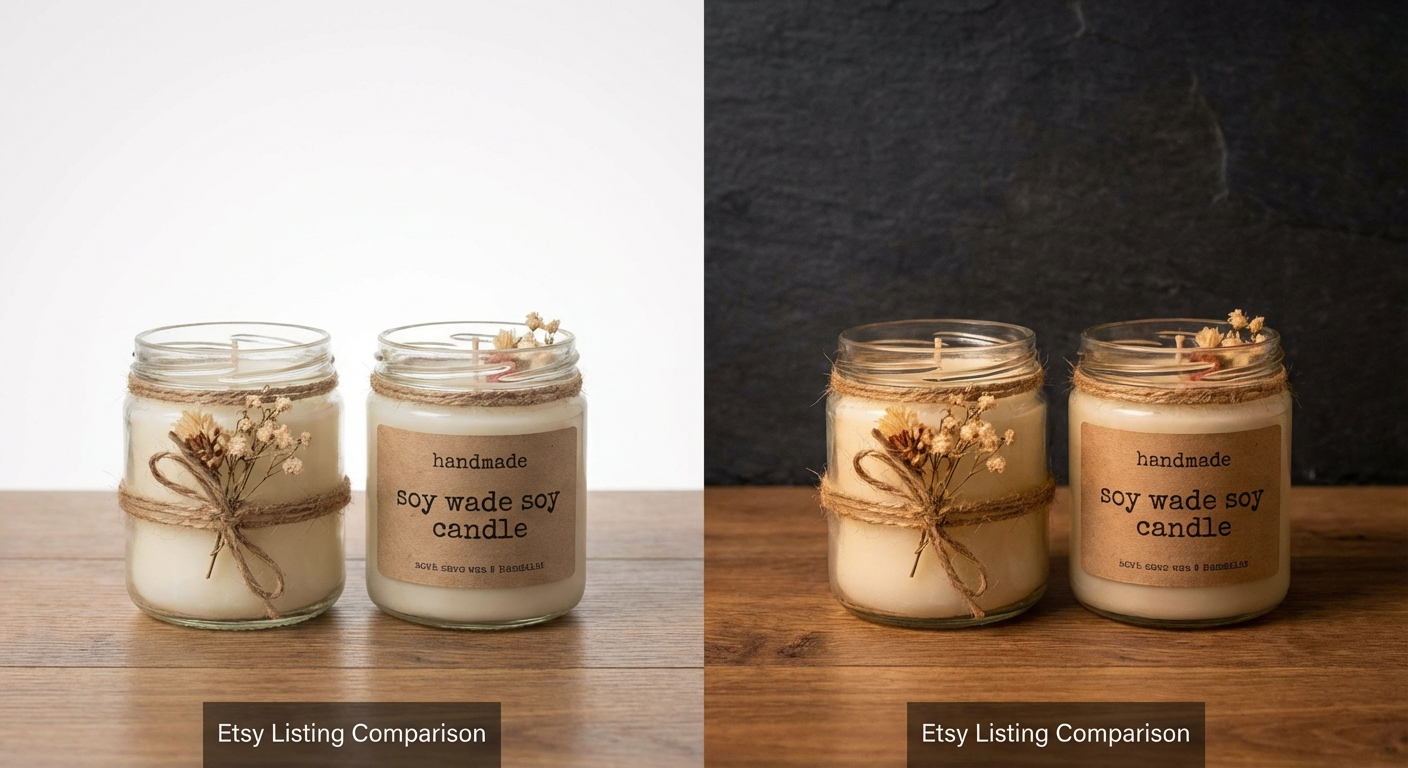 Product Lineup visual for Pricing Psychology and Fee Math for Etsy Sellers
Most Etsy sellers set prices by checking what competitors charge and matching them—or going slightly lower. That is a race to the bottom. Smart pricing combines accurate cost accounting with psychological triggers that make your price feel like a deal, even at premium levels.
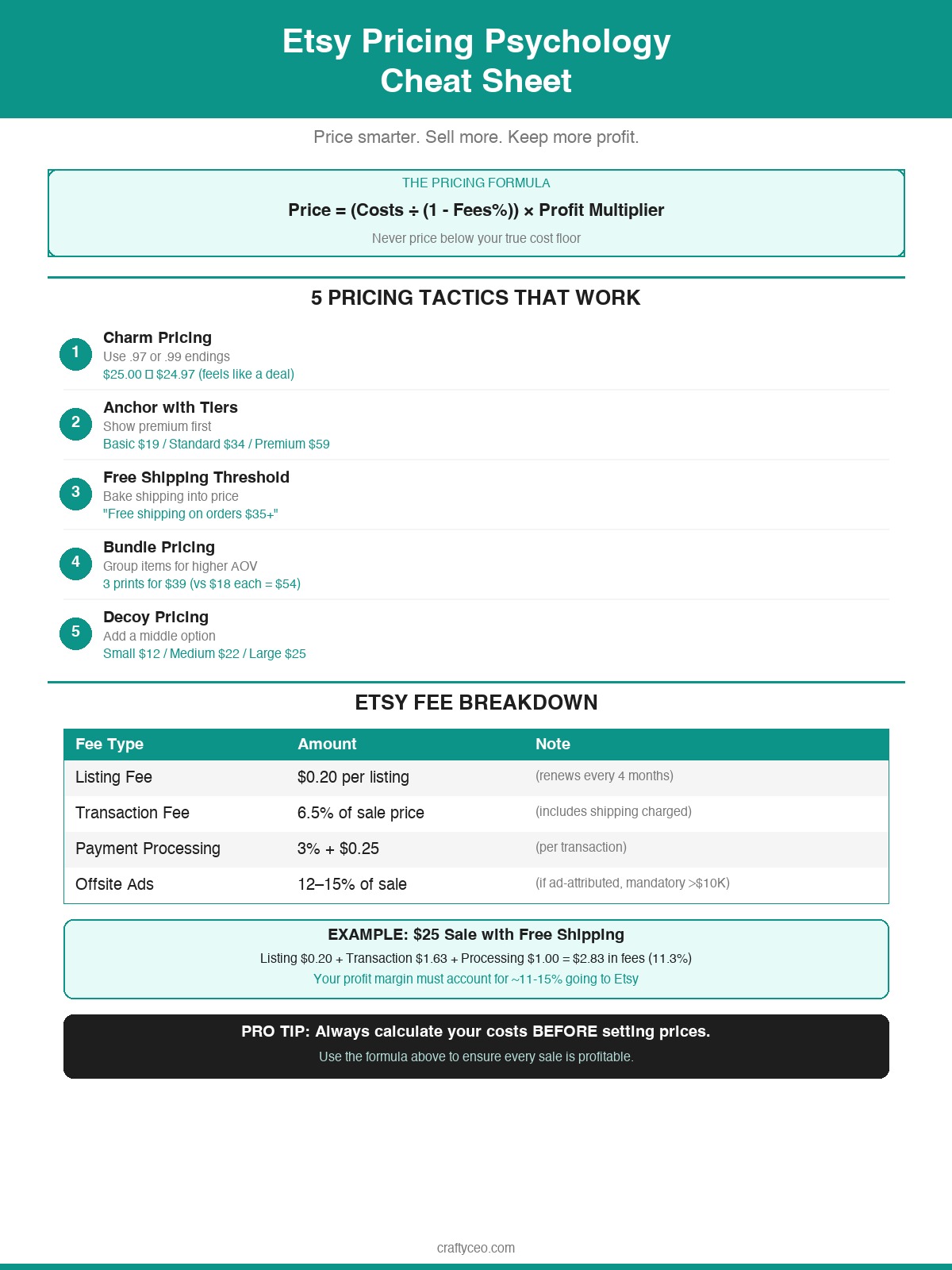
The Complete Etsy Fee Breakdown for 2026
Before you set a price, know your true cost structure:
| Fee Type | Amount |
|---|---|
| Listing fee | $0.20 per listing (renews every 4 months or on each sale) |
| Transaction fee | 6.5% of item price + shipping price |
| Payment processing | 3% + $0.25 per transaction |
| Offsite ads fee | 15% on sales from Etsy-sourced ads (shops under $10K/year); 12% for shops over $10K/year |
| Shipping label (if applicable) | Varies by weight and destination |
Combined take rate: For a typical sale, Etsy's fees total approximately 12–15% of your item price before offsite ads. If an offsite ad triggers the sale, add 12–15% on top of that.
The Pricing Formula
Price = (Materials + Labor + Overhead + Packaging + Shipping) ÷ (1 − Total Fee Percentage) × Profit Multiplier
Example:
- Materials: $6
- Labor (45 minutes at $25/hour): $18.75
- Packaging: $2
- Shipping materials: $1.50
- Total cost: $28.25
- Etsy fees at ~13%: divide by 0.87 = $32.47
- Profit multiplier of 1.5: $32.47 × 1.5 = $48.70 → Price at $48.97
You need to know your numbers cold. Sellers who price by gut feeling either undercharge (and burn out) or overcharge (and get no sales). For a complete breakdown, see our how to price handmade products guide.
Five Pricing Psychology Tactics That Increase Conversions
1. Charm Pricing (End in .97 or .99)
$29.97 feels meaningfully cheaper than $30.00 because buyers read prices left-to-right and anchor on the first digit. Research from the Journal of Consumer Psychology shows charm pricing increases purchase likelihood by 8–12% compared to round numbers. Use .97 for a slightly more premium feel than .99.
2. Anchor Pricing with Tiers
Offer three versions of your product: Basic ($24.97), Standard ($39.97), Premium ($59.97). Most buyers choose the middle option because it feels like the "smart" choice—not the cheapest (which feels risky) and not the most expensive (which feels indulgent). The premium tier makes the standard tier look reasonable by comparison.
3. Free Shipping Threshold
Etsy's algorithm favors listings with free shipping. Instead of absorbing shipping cost at a loss, build it into your product price and offer "free shipping." Better still, set a threshold: "Free shipping on orders over $35." Sellers who implement free shipping thresholds consistently see 15–25% increases in average order value because buyers add an extra item to qualify.
4. Bundle Pricing
Three items at $18 each, or a bundle of three for $47.97 (saving $6)? Bundles increase average order value, reduce per-item shipping cost, and make your shop feel curated and professional. Create bundles for obvious pairings: matching sets, gift collections, or "starter kits."
5. Decoy Pricing
Add a listing option that you don't expect many people to buy, but that makes your target option look more attractive. A $65 "deluxe" version with minor upgrades makes your $42 standard version feel like the obvious value pick.
Best Etsy Seller Tools for Listing Optimization
 Tips visual for Best Etsy Seller Tools for Listing Optimization
You do not need to do keyword research, tag analysis, and listing audits manually. These tools automate the tedious parts and surface insights you can't find on your own.
eRank — Etsy SEO & Analytics
Keyword explorer, listing audit tool, trend tracker, and competitor tag analysis. The listing audit grades your title, tags, and photos against best practices and shows exactly what to fix.
Free / $9.99/mo Pro
Try eRank →Marmalead — Keyword Research
AI-powered keyword suggestions with real Etsy search volume data. Shows engagement scores, competition levels, and click-through rates for each keyword so you can pick winners, not guesses.
$19/mo
Try Marmalead →Sale Samurai — Tag & Title Optimizer
Search analytics, tag suggestions, and listing optimization scores. The "Listing Analyzer" tool shows exactly which tags are underperforming and recommends replacements based on real search data.
$9.99/mo
Try Sale Samurai →Alura — All-in-One Etsy Toolkit
Shop analyzer, keyword explorer, listing builder, and trend tracker in one dashboard. Ideal for sellers who want everything consolidated without switching between multiple tools.
Free / $19.99/mo Pro
Try Alura →Vela — Bulk Listing Editor
Edit titles, tags, descriptions, and prices across hundreds of listings simultaneously. Essential for seasonal keyword rotation and shop-wide sales events. Saves hours of manual editing.
Free (100 edits/mo) / $5/mo
Try Vela →Canva Pro — Listing Graphics
Create professional product mockups, infographic images, size charts, and branded listing photos. Includes templates designed for Etsy's exact photo dimensions and aspect ratios.
Free / $12.99/mo Pro
Get Canva Pro →Advanced Listing Optimization Tactics
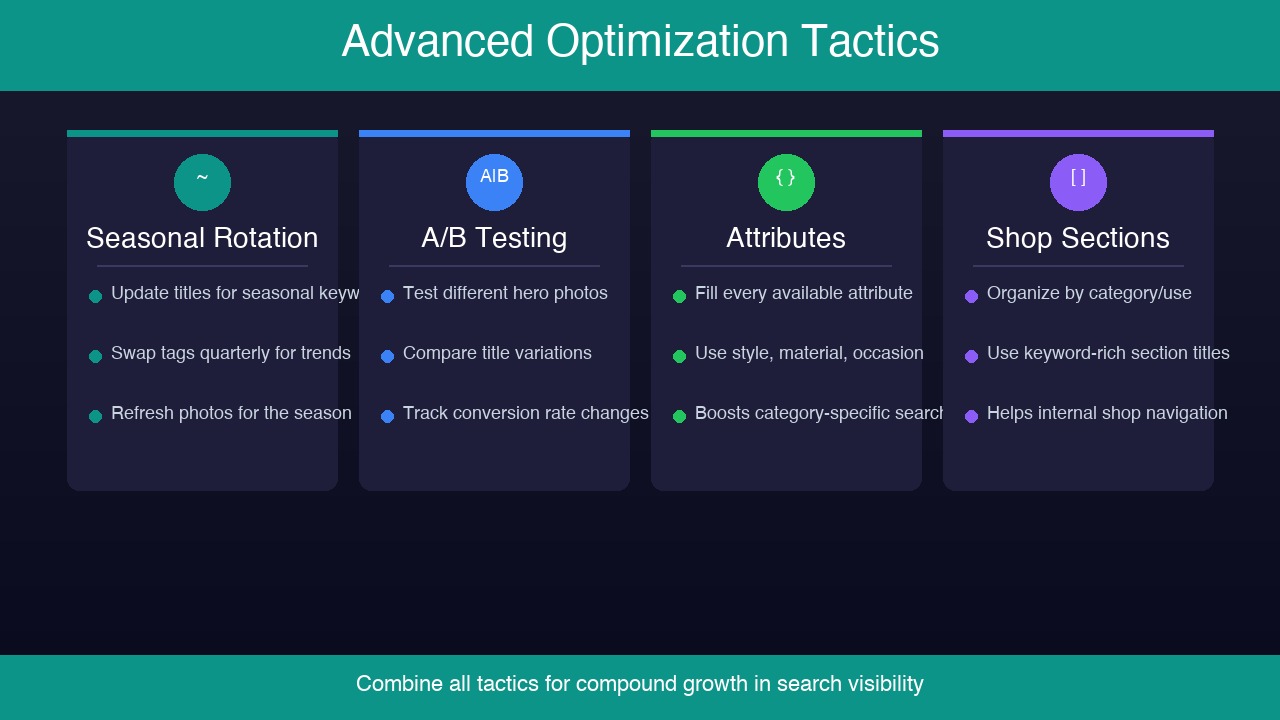
Once you have the fundamentals locked down—title, tags, description, photos, pricing—these advanced tactics create separation between your shop and competitors selling similar products.
Seasonal Keyword Rotation Calendar
Etsy search is seasonal. The same product can rank for completely different keywords depending on the time of year. Top sellers maintain a keyword rotation calendar and update their titles and tags 4–6 weeks before each season peaks:
- January–February: "Valentine's gift for him/her," "anniversary gift," "Galentine's gift"
- March–April: "Easter basket gift," "spring home decor," "Mother's Day gift"
- May–June: "wedding gift," "graduation gift," "Father's Day gift," "summer decor"
- July–August: "back to school," "teacher gift," "fall preview decor"
- September–October: "fall home decor," "Halloween gift," "Thanksgiving hostess gift"
- November–December: "Christmas gift," "holiday decor," "stocking stuffer," "Hanukkah gift"
The sellers who capture seasonal traffic first get the algorithm momentum. By the time most sellers update their keywords, the early movers already have the quality score advantage from weeks of seasonal sales.
Systematic A/B Testing
You cannot run native A/B tests on Etsy, but you can test systematically with a simple framework:
- Change ONE variable at a time. Title, hero photo, price, or tags. Never change two variables simultaneously—you won't know which one caused the result.
- Run the test for 14 days minimum. Etsy's algorithm needs time to reindex and stabilize. Shorter tests produce noisy, unreliable data.
- Record the baseline before you change anything. Screenshot your Stats page showing impressions, visits, and orders for the previous 14 days.
- Compare after 14 days. More impressions = better keyword targeting. Higher CTR = better hero photo or title. More orders = better conversion (description, price, photos).
- Keep winners, revert losers. After 3–4 rounds of testing over 2–3 months, your listing will perform at a level that most sellers never reach because they never test.
Track everything in a simple spreadsheet: listing title, variable changed, date range, impressions, visits, orders, revenue.
Attribute Optimization
Beyond title and tags, Etsy lets you set listing attributes: color, material, occasion, style, recipient, and more. Fill out every single attribute field. Attributes power Etsy's filter and browse features. When a buyer filters search results by "gold" + "minimalist" + "anniversary gift," only listings with those exact attributes set will appear.
Most sellers skip attributes because they feel optional. They are not optional—they are free visibility channels that your competitors are ignoring.
Section Organization
Organize your shop into logical sections (Etsy allows up to 20). Sections help buyers browse your shop and help Etsy's algorithm understand your product catalog. A well-organized shop with clear sections converts better because buyers can quickly find related products, leading to multi-item orders.
Listing Variation Strategy
Use listing variations (size, color, style) to consolidate reviews. Instead of creating five separate listings for five colors of the same product, create one listing with five color variations. All sales and reviews accumulate on a single listing, building social proof and quality score faster than five scattered listings ever could.
Listing Audit Checklist: Fix These Mistakes First
After auditing over 3,000 Etsy listings for consulting clients, these are the mistakes I see most often—ranked by impact on sales:
Mistake 1: Writing Titles for Humans Instead of Search
What it looks like: "Beautiful Handmade Mug — Perfect Gift!"
Why it hurts: This title targets zero search queries. "Beautiful" and "perfect" are not keywords buyers search for.
The fix: Replace every adjective with a searchable keyword. "Personalized Dog Mom Mug, Custom Pet Name Coffee Cup, Dog Lover Birthday Gift" targets five or more search queries from a single title.
Mistake 2: Using 3 Photos When You Have 10 Slots
What it looks like: Three nearly identical product shots from slightly different angles.
Why it hurts: Buyers have unanswered questions about size, quality, packaging, and variations. Unanswered questions kill conversions.
The fix: Follow the 10-photo sequence above. If you don't have enough physical angles, create infographic images (size charts, feature callouts) or add process and behind-the-scenes photos.
Mistake 3: Wasting Tags on Single Words
What it looks like: Tags like "mug," "gift," "cute," "handmade."
Why it hurts: Single-word tags face millions of competing listings. Your listing drowns in results.
The fix: Use multi-word phrases: "dog mom mug," "personalized pet gift," "custom coffee cup." Less competition, higher relevance, better conversion.
Mistake 4: Starting Descriptions with Shop Greetings
What it looks like: "Welcome to my shop! Thanks so much for stopping by!"
Why it hurts: The first 160 characters appear in search previews and Google snippets. A greeting tells the buyer nothing about your product.
The fix: Lead with the product's biggest benefit or most compelling feature. Save greetings for the About section of your shop.
Mistake 5: Pricing Without Fee Math
What it looks like: Pricing a product at $25 when materials + labor + fees total $22.
Why it hurts: You are working for $3 per sale before taxes. That is not a business—it is an expensive hobby.
The fix: Use the pricing formula above. Calculate every cost including ALL Etsy fees, materials, labor (value your time at $20+ per hour minimum), shipping, and packaging. Target a minimum 50% profit margin after fees.
Mistake 6: Ignoring Listing Analytics
What it looks like: Publishing a listing and never checking back on performance data.
Why it hurts: You have no feedback loop. Listings that could perform well with small tweaks languish because you never identified the problem.
The fix: Check your Etsy Stats weekly. Focus on three numbers per listing: impressions (are you being found?), visits (are buyers clicking?), and orders (are visitors buying?). Low impressions = keyword problem. Low visits relative to impressions = hero photo or title problem. Low orders relative to visits = description, price, or photo quality problem.
FAQ: Etsy Listing Optimization
Q: How many tags should I use on each Etsy listing in 2026?
A: Always use all 13 tags. Each tag allows up to 20 characters. Mix primary keywords, long-tail phrases, occasion-based terms, and style descriptors. Avoid repeating words already in your title because Etsy combines title and tags for search indexing. Every empty tag slot is a category of buyers who will never find your listing.
Q: What is the best Etsy title formula for ranking in search?
A: Use the formula: Primary Keyword + Descriptive Modifier + Use Case or Occasion + Secondary Keyword. Front-load your most important keyword in the first 40 characters because that is what shows in search results. Example: "Personalized Dog Collar, Custom Leather Pet Collar with Name, Puppy Gift."
Q: How long should an Etsy product description be for best conversions?
A: Aim for 300 to 600 words. The first 160 characters appear in search previews, so lead with your strongest benefit. Structure the rest with short paragraphs, bullet points for features and specifications, and a clear call to action at the end. Under 200 words feels thin and unprofessional; over 800 words is excessive for most products.
Q: Does renewing an Etsy listing help it rank higher?
A: Etsy gives a small temporary visibility bump to newly listed and renewed items. However, each renewal costs $0.20 and the boost fades within 24–72 hours. A stronger long-term strategy is to optimize your existing listings with strong keywords, quality photos, and competitive pricing rather than relying on renewal bumps.
Q: How many photos should I use in my Etsy listing?
A: Use all 10 photo slots. Listings with 7 or more photos convert at nearly double the rate of listings with 3 or fewer. Follow a deliberate sequence: hero shot, lifestyle image, detail close-up, size reference, variations, packaging, infographic, social proof, behind-the-scenes, and a second lifestyle angle.
Q: What Etsy listing mistakes hurt my search ranking the most?
A: The most damaging mistakes are: using only 1–3 photos instead of all 10 slots, writing titles with adjectives instead of search keywords, leaving tags empty or duplicating title words in tags, starting descriptions with shop greetings instead of product benefits, and pricing without calculating Etsy fees. Each of these issues directly reduces either your visibility in search or your conversion rate.
Q: How often should I update my Etsy listings?
A: Review your top 20 listings every month. Rotate seasonal keywords and occasion tags 4–6 weeks before each holiday or season. Replace underperforming tags based on your Etsy Stats search term data. Update hero photos if click-through rates are below 2%. Listings are living documents, not set-and-forget files.
About the Author
Emma Blake is an Etsy SEO consultant who has helped over 400 Etsy sellers optimize their listings for higher rankings and better conversion rates. With a background in search engine marketing and e-commerce analytics, Emma specializes in turning underperforming listings into top-of-search revenue drivers. She has personally audited over 3,000 Etsy listings across 50+ categories and writes about listing optimization, keyword strategy, and conversion psychology for The Crafty CEO. When she is not analyzing search data, she runs her own small-batch candle shop on Etsy.
Sources
- Etsy Seller Handbook — "How Etsy Search Works" (2026 update). Etsy, Inc.
- Etsy Q4 2025 Earnings Report — Marketplace GMV, Seller Growth Data, and Fee Structure. Etsy, Inc.
- "The Science of Pricing: How Charm Pricing Affects Consumer Behavior." Journal of Consumer Psychology, Volume 34, Issue 2, 2024.
- eRank 2026 Etsy Keyword Trends Report — Top Performing Keywords, Tag Analysis, and Category Benchmarks. eRank.com.
- Marmalead Annual Etsy SEO Report — Tag Strategy Analysis Across 1M+ Listings, Click-Through Rate Benchmarks. Marmalead.com, 2025.
- "E-Commerce Product Photography Best Practices and Conversion Impact." Shopify Research Lab, 2025.
- Etsy Marketplace Insights — "Understanding Listing Quality Score and Search Ranking Factors." Etsy Engineering Blog, 2025.