Guide
How to Price Handmade Products for Profit (2026 Guide)
By Emma Walsh, Etsy Business Consultant · Updated 2026-03-10
Pricing handmade products correctly is the single biggest factor between a thriving Etsy shop and one that quietly bleeds money. The proven formula is: (Materials + Labour + Overhead) × 2 = Wholesale Price, then Wholesale × 2 = Retail Price. Most handmade sellers skip labour and overhead entirely — meaning they earn less than minimum wage on every sale. This guide breaks down every cost you need to capture, shows you the exact formulas by product category, and gives you the confidence to charge what your work is actually worth.


Table of Contents
- Why Handmade Sellers Underprice (And What It Really Costs You)
- The COGS Formula: Materials, Labour, and Overhead
- Wholesale vs Retail Pricing Explained
- How Etsy Fees Impact Your Pricing
- Pricing by Product Category
- The Psychology of Pricing Handmade Goods
- When and How to Raise Your Prices
- Best Tools for Pricing and Accounting
- Frequently Asked Questions
Why Handmade Sellers Underprice (And What It Really Costs You)
If you have ever calculated your hourly earnings from a batch of handmade products and felt a sinking feeling in your stomach, you are not alone. A 2025 Craft Industry Alliance survey found that 68% of handmade sellers earn less than $7.25 per hour once all costs are factored in — well below the federal minimum wage.
The reasons sellers underprice are deeply human:
The "Hobby Mindset" Trap
Many makers start selling because friends and family say, "You should sell these!" The transition from hobbyist to business owner is gradual, and pricing habits formed in the hobby stage tend to stick. You would never expect a carpenter to charge only for lumber, yet handmade sellers routinely forget to charge for their own time.
Fear of Losing Sales
There is a persistent myth that Etsy shoppers only want bargains. In reality, Etsy's own marketplace data shows the average order value increased to $31.42 in 2025, and buyers specifically seek out handmade items because they expect to pay more for quality and uniqueness. Underpricing can actually signal low quality.
Comparison to Mass-Produced Goods
Comparing your hand-poured soy candles to a $6 Walmart candle is like comparing a tailored suit to fast fashion. They serve different markets. Your customer is choosing handmade intentionally — they expect and accept a premium.
Not Tracking True Costs
This is the most common and most damaging mistake. Without tracking every cost — from the gas you burn driving to the post office to the electricity powering your workshop — you are guessing at profitability. And most guesses are wildly optimistic.
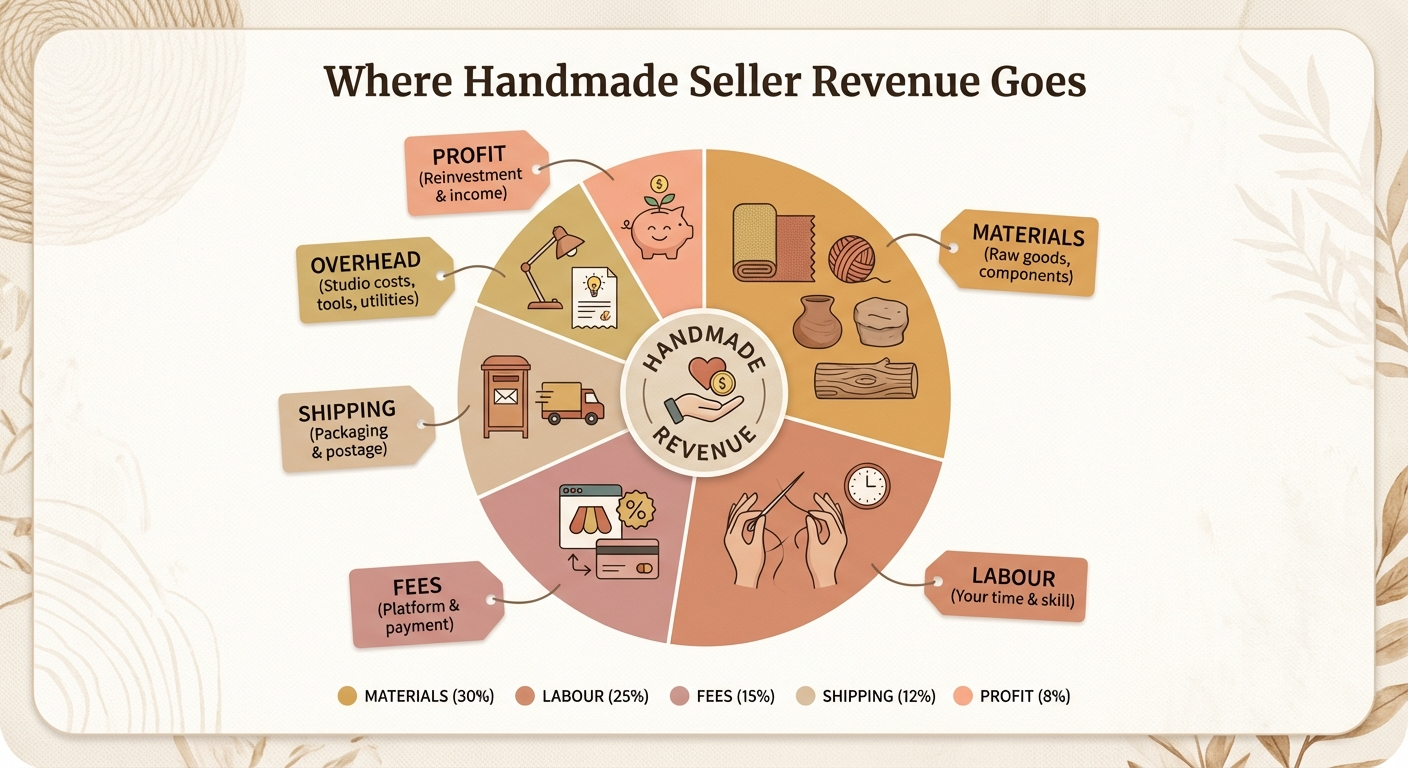 Most handmade sellers only account for materials — ignoring labour and overhead means working for less than minimum wage on every sale.

The bottom line: underpricing is not generosity — it is a business strategy that guarantees failure. If your shop cannot sustain itself financially, you will burn out and close, and your customers lose access to your work entirely.
The COGS Formula: Materials, Labour, and Overhead
COGS stands for Cost of Goods Sold, and it is the foundation of every profitable pricing strategy. Here is the complete breakdown:
Materials (Direct Costs)
Materials include everything that physically becomes part of the finished product or is consumed during production:
- Raw materials: fabric, yarn, wax, wire, beads, clay, wood
- Packaging: boxes, tissue paper, branded stickers, thank-you cards
- Shipping materials: mailers, bubble wrap, tape, labels
- Consumables: sandpaper, drill bits, sewing needles, glue sticks
Pro tip: Calculate material cost per unit, not per bulk purchase. If a $24 spool of wire makes 30 pairs of earrings, your wire cost is $0.80 per pair — not "basically free."
Labour (Your Time Has Value)
This is where most handmade sellers leave money on the table. Your labour includes:
- Production time: actual making of the product
- Preparation time: cutting, measuring, prepping materials
- Finishing time: quality checking, photographing, packaging
- Administrative time: listing creation, customer messages, bookkeeping
Set a minimum hourly rate and stick to it. A reasonable starting point for skilled handwork in 2026 is $20–$35 per hour, depending on your skill level, experience, and local cost of living. If you have been pricing at $10 per hour, you are subsidising your customers with your own unpaid labour.
Overhead (The Hidden Costs)
Overhead includes every cost required to operate your business that is not directly tied to a single product:
| Overhead Category | Examples |
|---|---|
| Workspace | Rent, mortgage portion, electricity, heating |
| Equipment | Sewing machine, kiln, 3D printer depreciation |
| Software | Etsy Plus, Canva, accounting software |
| Marketing | Promoted listings, social media tools |
| Insurance | Business liability, product insurance |
| Education | Workshops, courses, craft books |
| Transaction fees | Etsy fees, PayPal fees, tax prep |
To allocate overhead per product, total your monthly overhead costs and divide by the number of products you produce per month.
Example: If your monthly overhead is $600 and you make 120 candles per month, your overhead per candle is $5.00.
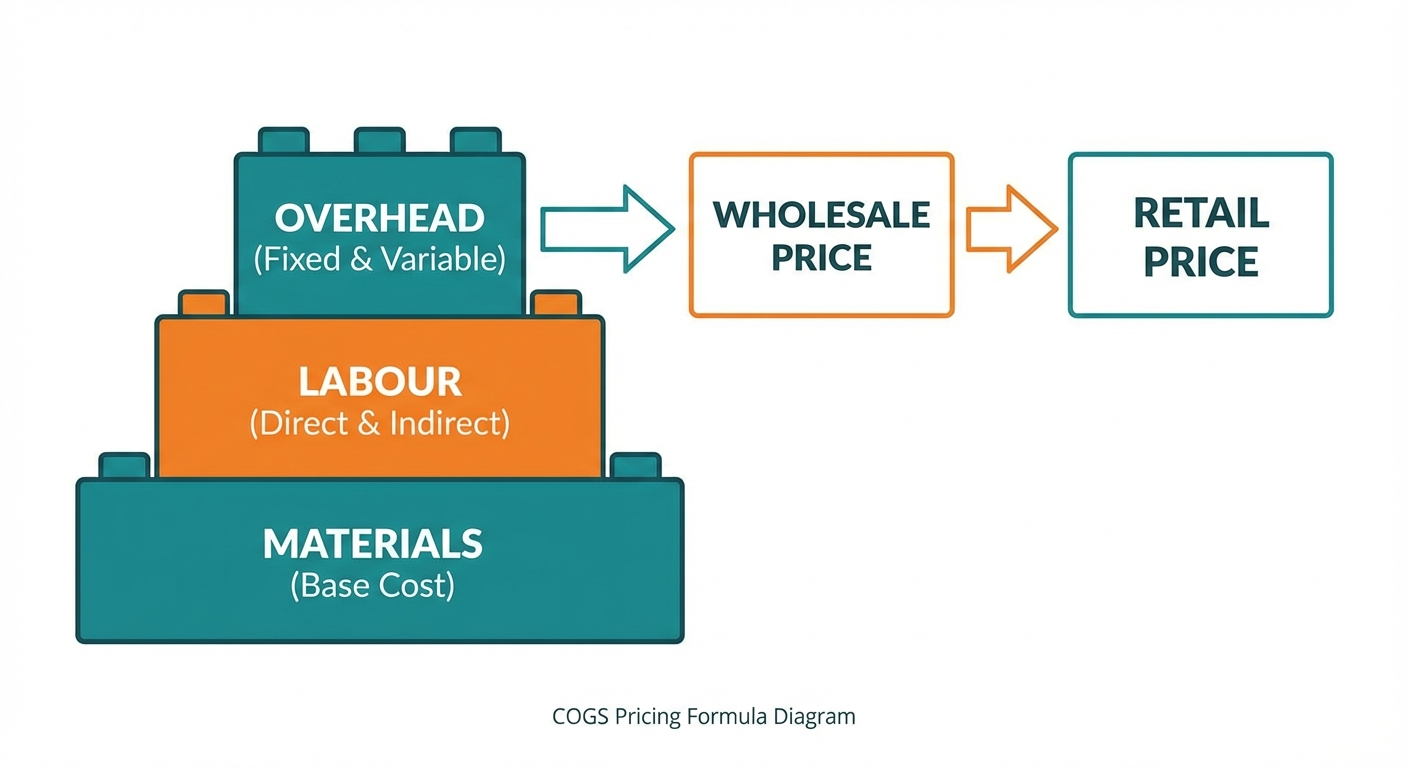 The COGS stacking method ensures every cost layer is captured before calculating your selling price.

The Complete Formula
Here is the standard pricing formula used by successful handmade business owners:
Materials + Labour + Overhead = COGS (Cost of Goods Sold)

COGS × 2 = Wholesale Price
Wholesale Price × 2 = Retail Price
Worked example — Hand-poured soy candle (8 oz):
| Cost Component | Amount |
|---|---|
| Wax, wick, fragrance oil, dye | $3.20 |
| Container (mason jar) | $1.50 |
| Label and packaging | $0.80 |
| Labour (15 min at $25/hr) | $6.25 |
| Overhead allocation | $5.00 |
| COGS | $16.75 |
| Wholesale Price (×2) | $33.50 |
| Retail Price (×2) | $67.00 |
Does $67 for a candle sound high? Premium handmade soy candles from established brands regularly sell for $48–$78 on Etsy. The formula works.
Wholesale vs Retail Pricing Explained
Understanding the difference between wholesale and retail pricing is critical — even if you never plan to sell wholesale. Here is why.
What Is Wholesale Pricing?
Wholesale is the price you charge when selling in bulk to another business (a boutique, a gift shop, an online retailer) who will then mark up your product and sell it to the end consumer. The standard wholesale markup is 2× your COGS.
What Is Retail Pricing?
Retail is the price the end consumer pays. The standard retail markup is 2× your wholesale price (or 4× your COGS).
Why the Double Markup Matters
"But I only sell on Etsy — I do not need wholesale pricing!"
You might think that, but consider these scenarios:
-
A boutique owner finds your Etsy shop and wants to carry your products. If your retail price is only 1.5× COGS, you literally cannot offer a wholesale discount without losing money.
-
You want to run a sale. A 25% off sale at retail pricing still leaves you with a healthy margin. At thin margins, any discount means a loss.
-
Etsy fees and advertising eat into margins. At retail pricing, you have a buffer. At cost-plus pricing, every fee is a direct hit to your income.
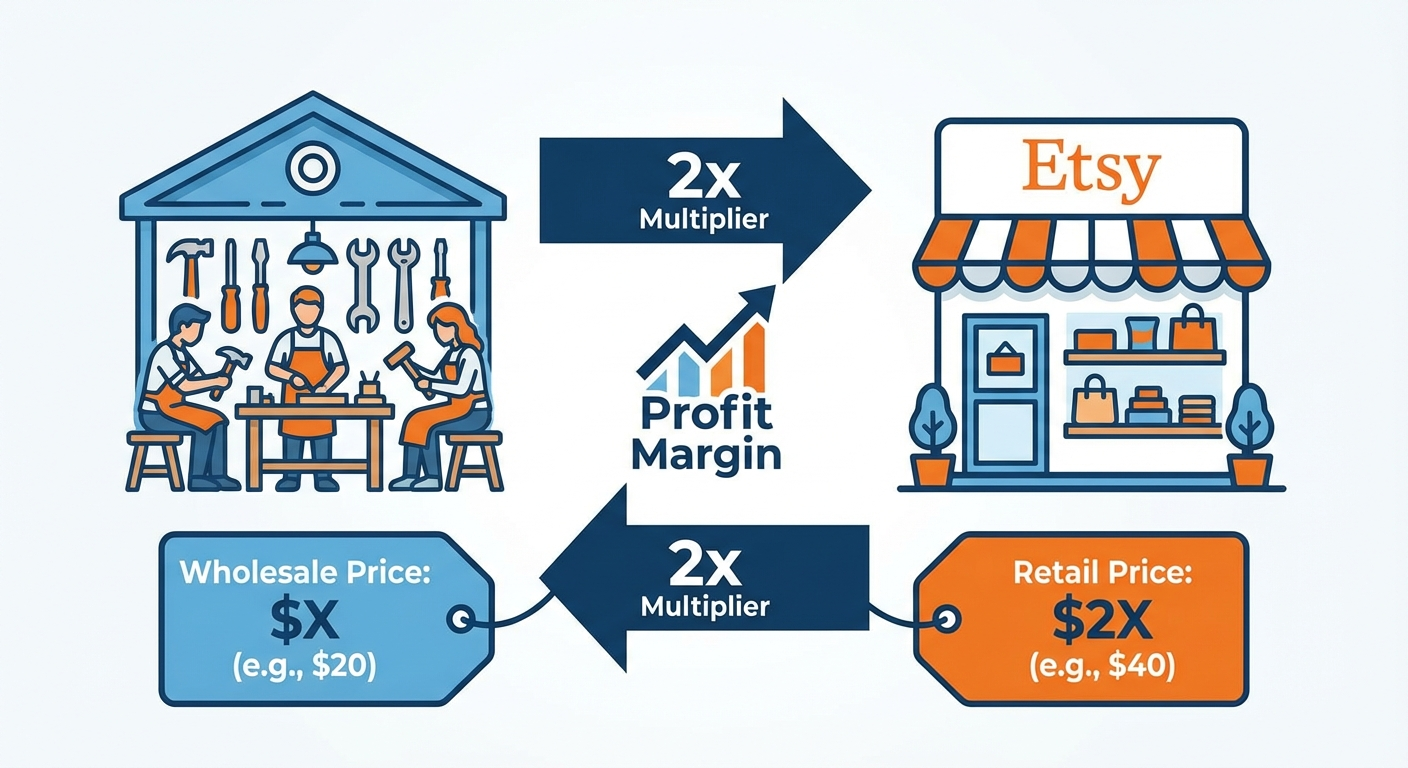 The keystone pricing method: wholesale = COGS × 2, retail = wholesale × 2. Gives you room for discounts without losing money.

When Keystone Markup Does Not Apply
The 2×/4× formula is a proven starting point, but some product categories command higher or lower multiples:
- Digital downloads: No COGS after creation, so pricing is value-based (typically $3–$25 per item with near-100% margin after initial creation time)
- Luxury or bridal items: 5×–8× COGS is common due to perceived value and emotional purchasing
- Commodity-adjacent goods: Products competing with mass-market equivalents may need lower multiples paired with strong brand positioning
How Etsy Fees Impact Your Pricing
Etsy's fee structure has grown more complex over the years. As of early 2026, here is exactly what you pay:
Current Etsy Fee Breakdown
| Fee Type | Amount | Notes |
|---|---|---|
| Listing fee | $0.20 per listing | Charged every 4 months or upon sale |
| Transaction fee | 6.5% of sale price | Includes shipping charged to buyer |
| Payment processing | 3% + $0.25 | Etsy Payments (US rate) |
| Offsite Ads fee | 12–15% | Only if sale comes from Etsy ad; mandatory for shops over $10K annual revenue |
| Currency conversion | 2.5% | For international sales |
The Real Cost of an Etsy Sale
Let us calculate the total fees on a $50 sale with $5.95 shipping:
| Fee | Calculation | Amount |
|---|---|---|
| Listing fee | Flat | $0.20 |
| Transaction fee | 6.5% × $55.95 | $3.64 |
| Payment processing | 3% × $55.95 + $0.25 | $1.93 |
| Total fees | $5.77 | |
| Fee percentage | $5.77 ÷ $50.00 | 11.5% |
If an Offsite Ads click generated that sale, add another $6.00–$8.39, bringing total fees to roughly 23–28% of the item price.
This is precisely why the wholesale/retail pricing model is so important. If you price at only 1.5× COGS, Etsy fees alone can eliminate your profit.
How to Build Fees Into Your Price
The simplest approach: after calculating your retail price using the COGS formula, add a fee buffer of 12–15%.
Final Etsy Price = Retail Price ÷ (1 – 0.13)
Using our candle example: $67.00 ÷ 0.87 = $77.01 (round to $76.99 for psychological pricing).
If that feels high, remember: your alternative is working for free. If the market will not bear the price, the solution is to reduce COGS (cheaper materials, faster production), not to slash your labour rate.
For more on optimising your shop setup and reducing wasted effort, read our guide on how to start an Etsy shop in 2026.
Pricing by Product Category
Different handmade categories have different cost structures, customer expectations, and competitive landscapes. Here is how to approach pricing for the most popular Etsy categories.
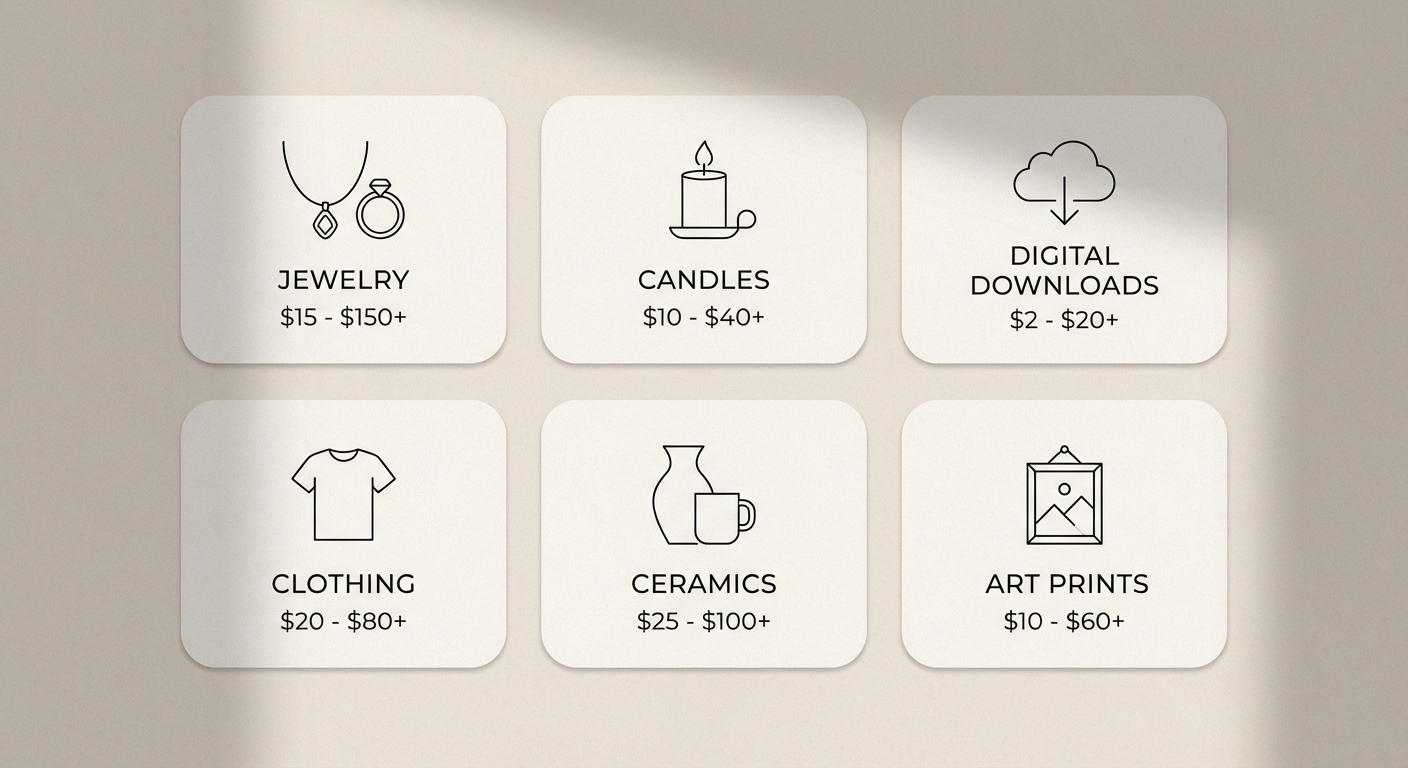

Handmade Jewelry
Jewelry has one of the widest price ranges on Etsy, from $8 beaded bracelets to $500 gold-filled statement pieces.
Key pricing factors:
- Material cost varies enormously: sterling silver vs plated, genuine gemstones vs glass
- Skill premium is high: metalsmithing and stone setting command higher rates than basic stringing
- Photography matters more: well-styled jewelry photos justify 30–50% higher prices
Typical benchmarks: Simple beaded earrings ($18–$35), wire-wrapped pendants ($35–$65), sterling silver handcrafted rings ($55–$150+)
Candles and Home Fragrance
The candle market on Etsy is crowded, which makes branding and perceived value critical.
Key pricing factors:
- Wax type matters: soy and coconut blends command premiums over paraffin
- Container costs add up fast — custom or reusable vessels justify higher prices
- Scent development time (testing, sourcing) is a hidden labour cost
Typical benchmarks: 4 oz tins ($12–$18), 8 oz jars ($22–$38), luxury 16 oz ($40–$68)
Digital Downloads
Digital products have a unique cost structure: high upfront creation cost, near-zero marginal cost.
Key pricing factors:
- Price for value delivered, not time spent per unit sold
- A wedding planner template that saves 20 hours of planning is worth $15–$35, regardless of your creation time
- Volume potential is unlimited — a single listing can sell thousands of times
Typical benchmarks: Simple wall art prints ($3–$8), planners and organisers ($8–$18), business templates ($15–$45), course materials ($25–$75)
Clothing and Accessories
Handmade clothing faces the steepest competition from fast fashion, but the target customer is fundamentally different.
Key pricing factors:
- Fabric cost per garment (factor in waste/scrap)
- Sewing time is significant — a lined dress can take 4–8 hours
- Sizing complexity adds production and return costs
Typical benchmarks: Simple accessories ($20–$45), tops and skirts ($55–$120), dresses ($85–$250+)
Ceramics and Pottery
Ceramics have high overhead costs (kiln electricity, studio rent, glaze materials) and a significant breakage/loss rate.
Key pricing factors:
- Factor in kiln firing costs per piece (electricity is not trivial)
- Build a breakage rate into pricing (5–15% of pieces may crack or fail)
- Drying and firing time means long production cycles
Typical benchmarks: Mugs ($25–$45), bowls ($30–$55), vases ($45–$120+)
The Psychology of Pricing Handmade Goods
Pricing is not purely mathematical — human psychology plays a massive role in purchasing decisions. Understanding these principles can help you price more effectively without leaving money on the table.
Charm Pricing (The .99 Effect)
Prices ending in .99 or .95 are perceived as significantly lower than the next round number. A candle priced at $34.99 feels cheaper than $35.00, even though the difference is a single cent. This effect is well-documented in consumer research and works particularly well for items under $100.
However, for luxury or premium handmade goods, round numbers ($50, $75, $100) signal quality. If your brand positioning is upscale, charm pricing can actually undermine perceived value.
Anchoring
When customers see a higher price first, subsequent prices feel more reasonable. Use this by:
- Listing your most expensive variant first in a listing with multiple options
- Showing "Compare at" pricing if you also sell at craft fairs at higher prices
- Creating a premium line that makes your standard line feel accessible
The Rule of Three
Offering three price tiers (basic, standard, premium) drives most customers to the middle option. A candle shop might offer:
- 4 oz travel candle — $16 (entry point)
- 8 oz signature candle — $34 (target — most customers choose this)
- 16 oz luxury candle — $58 (aspiration anchor)
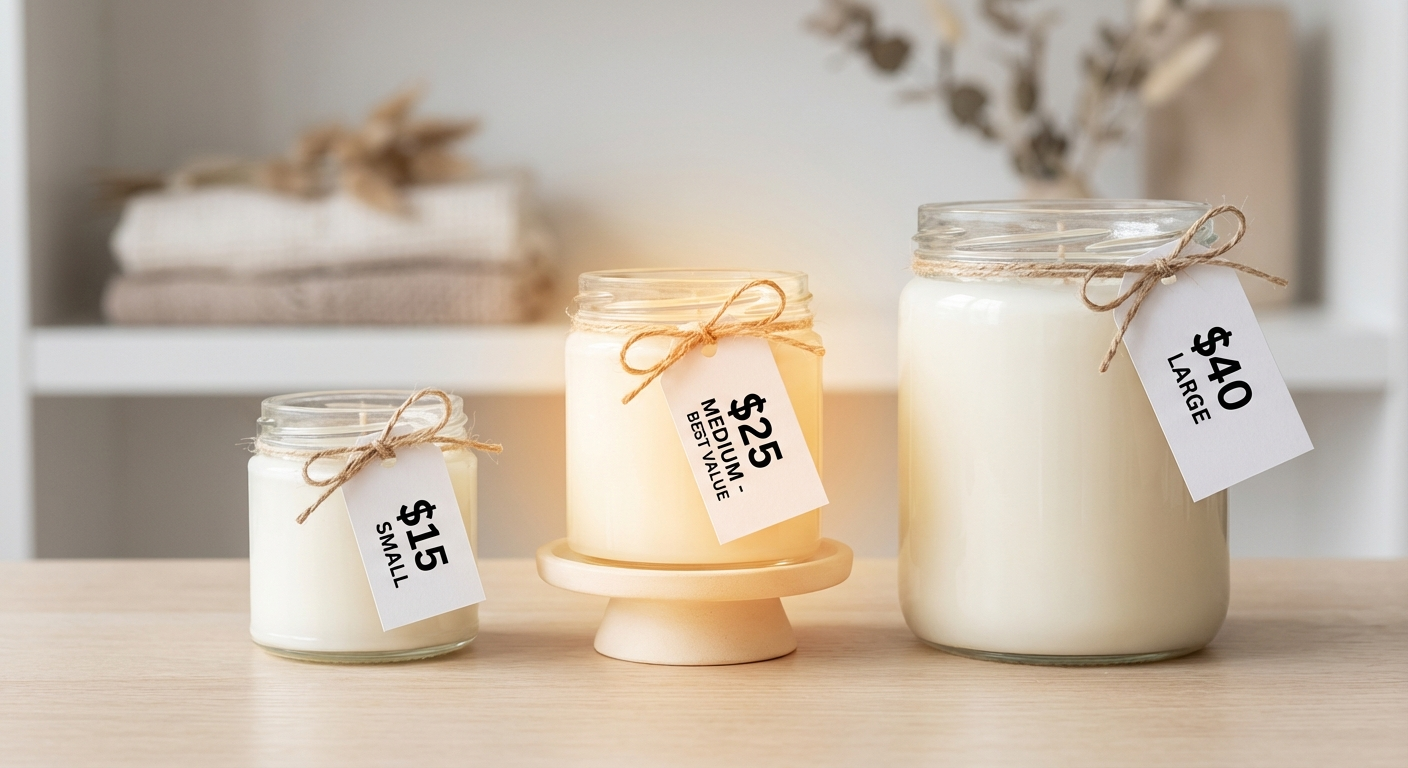 Three-tier pricing anchors buyers to the middle option — typically your highest margin product.

Perceived Value Boosters
These strategies let you command higher prices without changing the product itself:
- Professional photography: listings with styled, high-quality photos convert at higher price points. Learn how to get found with our best Etsy SEO tools guide
- Storytelling: share the making process, the inspiration, and your journey — customers pay more when they connect with the maker
- Packaging experience: unboxing videos drive social sharing, which justifies premium pricing
- Social proof: reviews mentioning quality and value reinforce pricing
The Underpricing Paradox
Counterintuitively, raising prices can increase sales. When a jewellery maker raised her earring prices from $22 to $38, her conversion rate actually improved by 15%. Why? At $22, shoppers assumed the materials were cheap. At $38, the same earrings signalled quality, and customers trusted the purchase.
When and How to Raise Your Prices
If you have been underpricing, the thought of raising prices can be terrifying. Here is when it is necessary and how to do it with confidence.
Signs You Need a Price Increase
- You are consistently sold out: high demand with limited supply means your prices are too low
- Your hourly rate is below $15: you are subsidising your customers
- Material costs have risen: inflation, supply chain changes, or supplier price increases
- You have improved your skills: better craftsmanship justifies higher prices
- You are burning out: if the volume required to pay bills is unsustainable, prices need to go up
How to Raise Prices Without Losing Customers
- Raise gradually: 10–15% increments are less jarring than sudden jumps
- Add value with the increase: improved packaging, a thank-you note, or a small freebie
- Grandfather existing customers: offer loyal buyers a discount code for their next purchase
- Announce with confidence: "Due to increased material costs and our commitment to quality, prices will be updated on [date]"
- Do not apologise: your pricing reflects the value of your work — period
What About Existing Listings?
Update all listings at once rather than piecemeal. A staggered approach creates pricing inconsistencies that confuse customers and make your shop look disorganised.
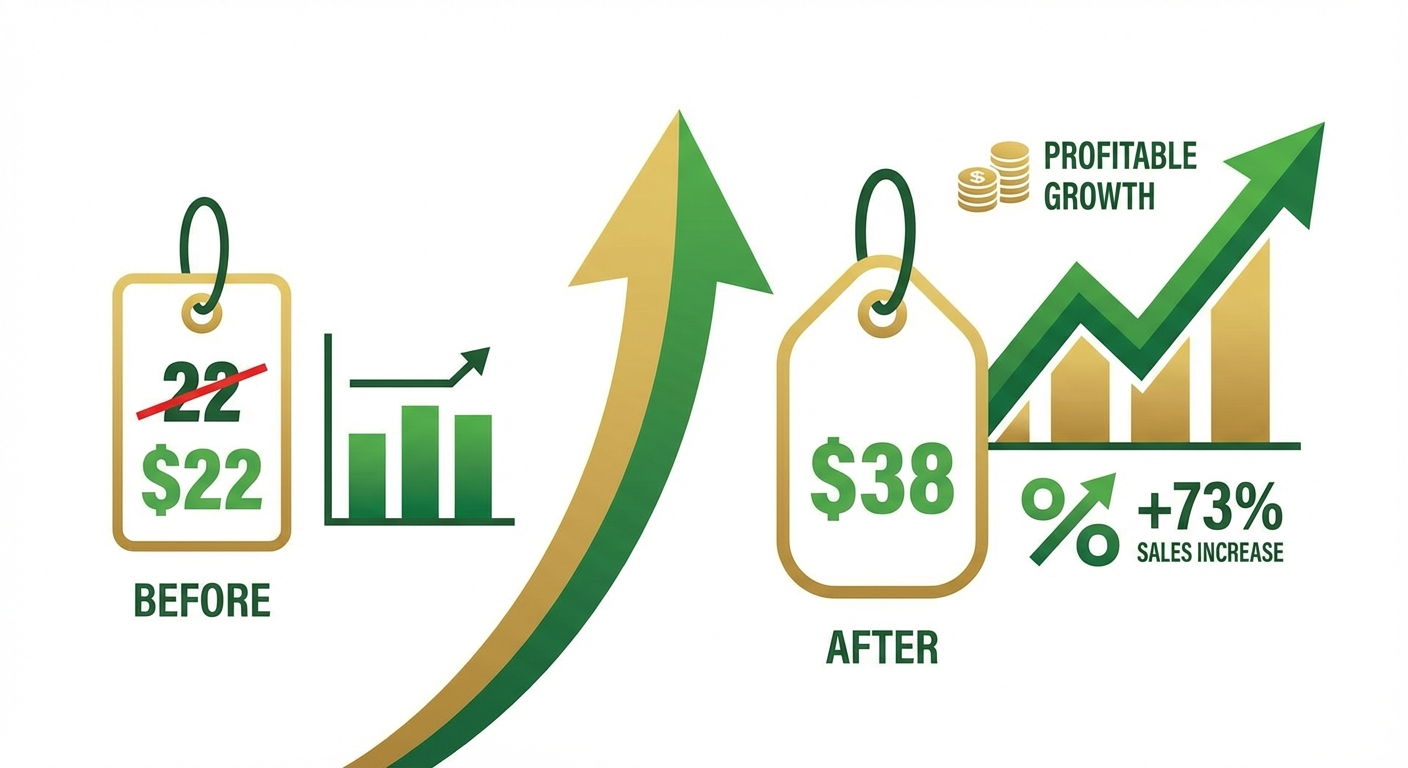 Counter-intuitively, many Etsy sellers find that raising prices increases sales by improving perceived value.

To stay disciplined with pricing reviews and other business habits, track your Etsy business habits with a dedicated planner.
Best Tools for Pricing and Accounting
The right tools eliminate guesswork and save hours of manual calculation. Here are the best options for handmade sellers in 2026.
QuickBooks Self-Employed
Best for: Sellers earning $1K+/month
QuickBooks automatically tracks expenses, separates business and personal spending, and calculates quarterly tax estimates. The mobile app lets you snap receipts on the go.
- Automatic Etsy import via API
- Mileage tracking for craft fair sellers
- Schedule C tax preparation
- Starting at $15/month
Wave Accounting
Best for: New sellers on a budget
Wave is completely free accounting software with invoicing, receipt scanning, and financial reporting. It lacks some of QuickBooks' automation but is more than sufficient for sellers doing under $1K/month.
- Free forever (no trial limitations)
- Professional invoicing for wholesale orders
- Bank connection for automatic categorisation
- Paid add-ons for payroll if you hire help
Etsy Fee Calculator (Craftybase)
Best for: Understanding per-listing profitability
Craftybase is purpose-built for handmade sellers. It calculates material costs, tracks inventory, and shows you exactly what you earn per listing after all Etsy fees.
- Material and supply tracking per product
- Automatic Etsy fee calculation
- COGS reporting for tax time
- Starting at $19/month
DYMO LabelWriter 450
Best for: Professional shipping labels
Stop handwriting addresses and wasting ink on full-sheet labels. A dedicated label printer pays for itself within weeks for active shops.
- Prints shipping and product labels
- No ink cartridges (thermal printing)
- Compatible with Etsy shipping labels
- One-time investment
Rollo Wireless Shipping Label Printer
Best for: High-volume sellers
The Rollo handles 4×6 shipping labels at speed and connects wirelessly to your computer or phone. A favourite among Etsy sellers processing 10+ orders per day.
- Wireless connectivity (Wi-Fi and Bluetooth)
- Works with Etsy, USPS, UPS, FedEx
- 150 mm/s print speed
- No ink or toner required
Google Sheets Pricing Template
Best for: Sellers who want full control
Sometimes a spreadsheet is all you need. Create columns for every cost component, build in formulas for the COGS calculation, and you have a free, customisable pricing tool.
- Completely free
- Fully customisable to your products
- Shareable with business partners or accountants
- Templates available on Etsy (search "pricing spreadsheet")

Putting It All Together: Your Pricing Action Plan
Here is a step-by-step plan to implement everything in this guide:
- Audit your current costs: List every material, supply, and overhead expense for the past 3 months
- Set your hourly rate: Choose a rate that reflects your skill level (minimum $20/hr in 2026)
- Calculate COGS per product: Materials + Labour + Overhead for each item you sell
- Apply the formula: COGS × 2 = Wholesale, Wholesale × 2 = Retail
- Add the Etsy fee buffer: Divide retail price by 0.87 to cover platform fees
- Compare to market: Check competitors, but do not race to the bottom
- Update your listings: Change all prices at once with a brief announcement
- Review quarterly: Costs change — your prices should too
The sellers who thrive on Etsy in 2026 are not the ones with the lowest prices. They are the ones who understand their numbers, price with confidence, and deliver value that justifies every penny.
Frequently Asked Questions
How do I calculate the cost of my time for handmade products?
Track how long each product takes from start to finish — including preparation, production, finishing, photography, and listing time. Multiply total hours by your chosen hourly rate (recommended minimum of $20–$35/hr for skilled handwork in 2026). Many sellers use a stopwatch app for the first 5–10 batches until they have reliable time averages.
What if my prices are higher than competitors on Etsy?
Higher prices are not inherently a problem. Differentiate through superior photography, compelling product descriptions, unique materials, and outstanding customer service. Etsy buyers who filter by "handmade" are already expecting to pay more. Focus on communicating why your product is worth the price rather than trying to match the lowest seller.
Should I offer free shipping or build it into the price?
Etsy's algorithm favours free shipping listings, especially for orders over $35. The recommended approach is to build shipping costs into your product price and offer "free" shipping. This simplifies the buying decision and improves search visibility. Just make sure your COGS calculation includes the actual shipping cost per unit.
How often should I review and adjust my prices?
Review pricing quarterly at minimum. Check for material cost changes, shifts in your production efficiency, new Etsy fee structures, and changes in market demand. Major cost increases (e.g., a supplier raising prices 20%) should trigger an immediate price review rather than waiting for the next quarter.
Can I price differently for Etsy vs craft fairs vs my own website?
Yes, and many successful sellers do. Craft fair prices can be slightly higher (no platform fees, and customers value the in-person experience). Your own website prices can be slightly lower than Etsy (no Etsy fees) or the same (with faster shipping or exclusive products as the differentiator). Just maintain consistency within each channel to avoid customer confusion.
How do I handle custom orders and pricing for one-of-a-kind pieces?
For custom work, start with your standard COGS formula and add a customisation premium of 20–50% to account for additional consultation time, design revisions, and the inability to batch-produce. Communicate this clearly upfront: "Custom pieces start at [base price] with final pricing based on complexity and materials selected." Always require a non-refundable deposit before starting custom work.
About the Author
Emma Walsh is an Etsy business consultant and former top 1% Etsy seller who has helped over 2,000 makers transition from hobby to profitable business. With a background in small business accounting and 8 years of hands-on experience selling handmade jewellery, Emma specialises in the financial foundations that turn creative passion into sustainable income. She writes for several maker-focused publications and hosts the Priced Right workshop series for emerging Etsy sellers.
Sources
- Craft Industry Alliance. "2025 Maker Income Survey: Earnings, Hours, and Profitability in the Handmade Economy." Craft Industry Alliance, 2025.
- Etsy Inc. "Etsy Marketplace Insights: Seller Handbook — Pricing Your Items." Etsy, 2025.
- U.S. Small Business Administration. "Pricing Your Products: A Guide for Small Business Owners." SBA.gov, 2025.
- Tyagi, R. and Whitfield, M. "Consumer Price Perception in Artisan Markets: The Role of Anchoring and Charm Pricing." Journal of Consumer Psychology, vol. 34, no. 2, 2025, pp. 112–128.
- Etsy Inc. "Etsy Fees and Payments Policy." Etsy Help Centre, updated January 2026.
- National Association for the Self-Employed. "Pricing Strategies for Micro-Businesses: 2025 Annual Report." NASE, 2025.