Guide
Etsy vs Shopify: Which Platform Should You Use?
By Ashley Park · Updated 2026-03-23
Etsy is a marketplace with 90+ million active buyers and low startup costs, making it ideal for new sellers. Shopify is a standalone e-commerce platform that gives you full brand control, better margins at scale, and advanced customization. The right choice depends on your budget, growth stage, and whether you need built-in traffic or brand independence.
Written by Ashley Park, E-commerce Business Consultant · Last updated March 23, 2026
This article contains affiliate links. If you purchase through our links, we may earn a small commission at no extra cost to you. See our affiliate disclosure for details.
Table of Contents
- Platform Overview: Etsy vs Shopify at a Glance
- Fees and Pricing Compared
- Ease of Use and Setup
- Design, Branding, and Customization
- Traffic, Marketing, and SEO
- Scalability and Growth Features
- Who Should Use Etsy (And When)
- Who Should Use Shopify (And When)
- Can You Use Both? The Multi-Channel Strategy
- Essential Tools and Resources for E-commerce Sellers
- Frequently Asked Questions
- Sources and Methodology
Platform Overview: Etsy vs Shopify at a Glance
Before diving into details, here is the fundamental difference between these two platforms.
Etsy is a marketplace. Think of it like renting a booth at a craft fair that attracts 90 million visitors. You benefit from the foot traffic, but you share the space with competitors, follow the fair's rules, and pay a cut of every sale.
Shopify is an e-commerce platform. Think of it like building your own storefront on your own street. You control the layout, the branding, the customer experience, and the data — but you are responsible for driving people through the door.
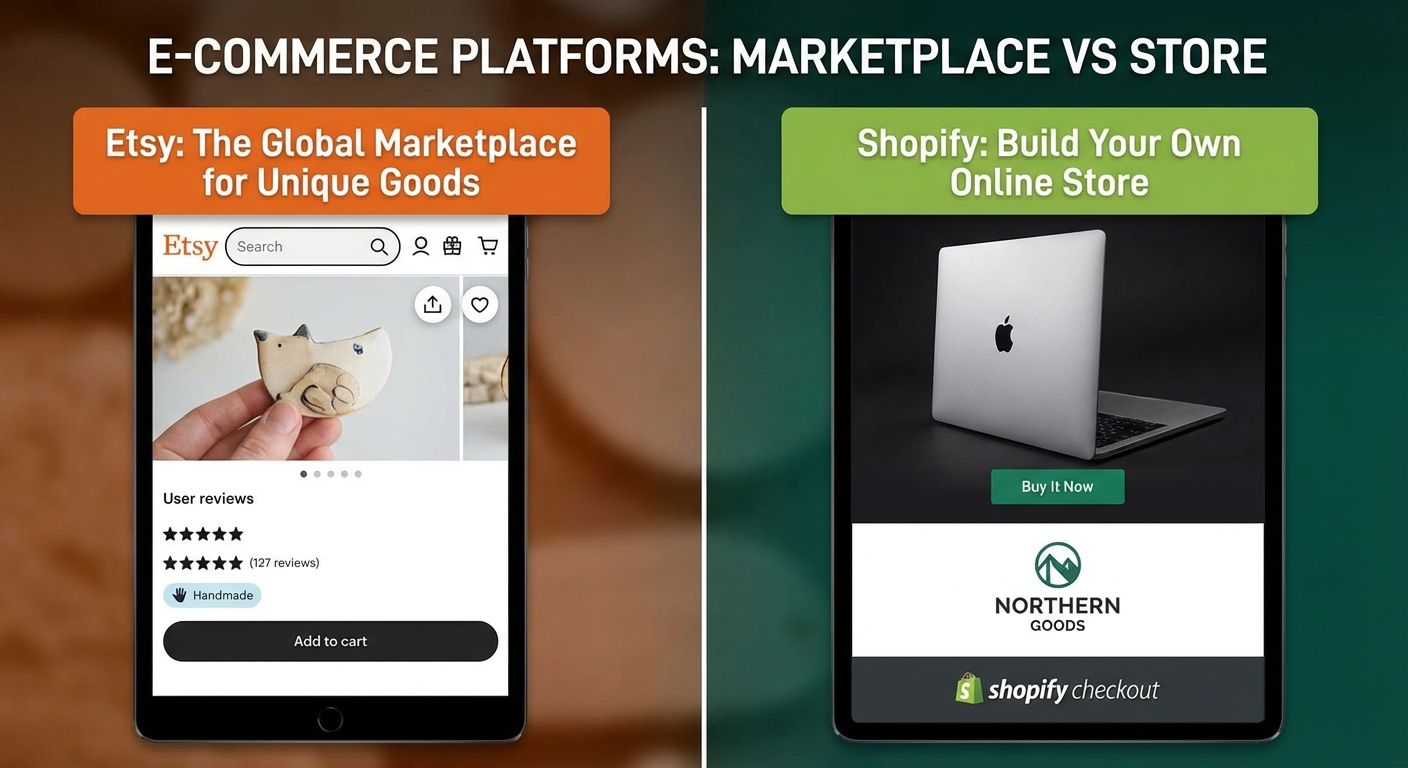
Neither platform is objectively "better." They serve different purposes at different stages of a business. Many of the most successful sellers I have worked with use both.
| Feature | Etsy | Shopify |
|---|---|---|
| Type | Online marketplace | Standalone e-commerce platform |
| Monthly Cost | $0 (Standard) / $10 (Plus) | $39–$399/month |
| Transaction Fee | 6.5% + payment processing | 0% (Shopify Payments) + processing |
| Built-in Traffic | Yes — 90M+ active buyers | No — you drive your own traffic |
| Custom Domain | No (etsy.com/shop/name) | Yes — full custom domain |
| Design Control | Limited templates | Full theme customization |
| SEO Control | Tags and titles only | Full meta, URL, blog, sitemap |
| Best For | New sellers, handmade, vintage, digital | Established brands, scaling, multi-product |
If you are starting from zero, I recommend reading our complete guide to starting an Etsy shop in 2026 alongside this comparison so you understand what the setup process actually looks like.
Fees and Pricing Compared
Fees are the number one factor that drives sellers from one platform to the other. Let me break down exactly what each platform costs in 2026.
Etsy Fee Structure
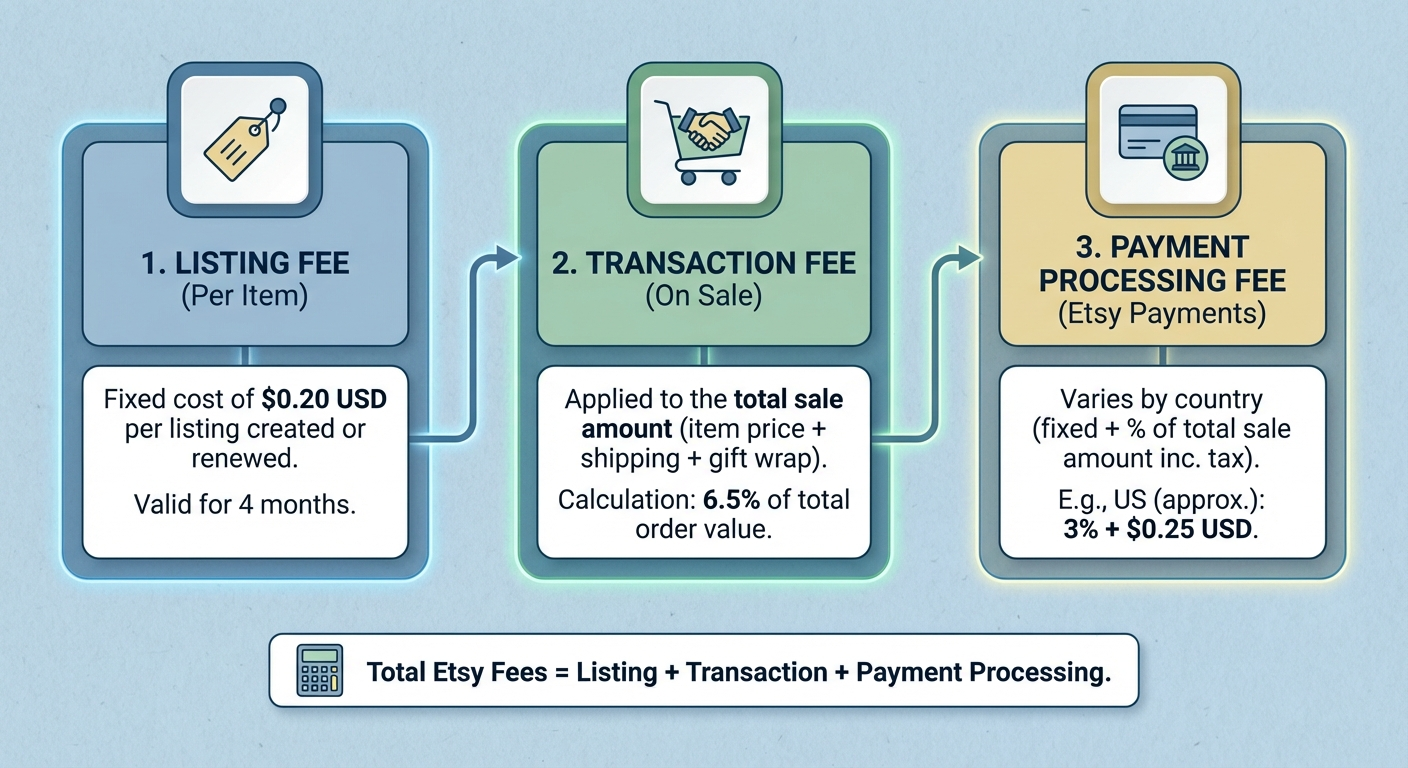
Etsy charges fees at multiple touchpoints:
- Listing fee: $0.20 per listing (renewed every 4 months or upon sale)
- Transaction fee: 6.5% of the total sale price (including shipping)
- Payment processing: 3% + $0.25 per transaction (Etsy Payments)
- Offsite ads fee: 15% on sales from Etsy's offsite advertising (12% for shops earning $10,000+/year). Shops earning over $10,000 annually cannot opt out.
- Etsy Plus: Optional $10/month for shop customization features, credits, and discounts
For a $30 product with $5 shipping, your Etsy fees break down like this:
| Fee Type | Amount |
|---|---|
| Listing fee | $0.20 |
| Transaction fee (6.5% of $35) | $2.28 |
| Payment processing (3% + $0.25) | $1.30 |
| Total fees | $3.78 (10.8% of sale) |
If that sale came through an Etsy offsite ad, add another $5.25 (15% of $35), bringing total fees to $9.03 — or 25.8% of the sale.
Shopify Fee Structure
Shopify charges a flat monthly subscription with lower per-transaction costs:
| Plan | Monthly Cost | Credit Card Rate | Transaction Fee |
|---|---|---|---|
| Basic | $39/month | 2.9% + $0.30 | 0% with Shopify Payments |
| Shopify | $105/month | 2.7% + $0.30 | 0% with Shopify Payments |
| Advanced | $399/month | 2.5% + $0.30 | 0% with Shopify Payments |
For that same $30 product with $5 shipping on Shopify Basic:
| Fee Type | Amount |
|---|---|
| Credit card processing (2.9% + $0.30) | $1.32 |
| Monthly plan (prorated per sale)* | Varies |
| Total per-transaction fees | $1.32 (3.8% of sale) |
*The monthly plan cost is fixed regardless of sales volume, so your effective per-sale cost decreases as volume increases.
The Breakeven Math
Here is where it gets practical. At what sales volume does Shopify become cheaper than Etsy?
Assuming an average order value of $35 and Shopify Basic at $39/month:
- At 20 sales/month ($700 revenue): Etsy costs ~$75.60 in fees. Shopify costs ~$65.40 ($39 plan + $26.40 processing). Shopify wins.
- At 10 sales/month ($350 revenue): Etsy costs ~$37.80 in fees. Shopify costs ~$52.20 ($39 plan + $13.20 processing). Etsy wins.
- Breakeven point: Roughly 14–16 sales per month at a $35 average order value.
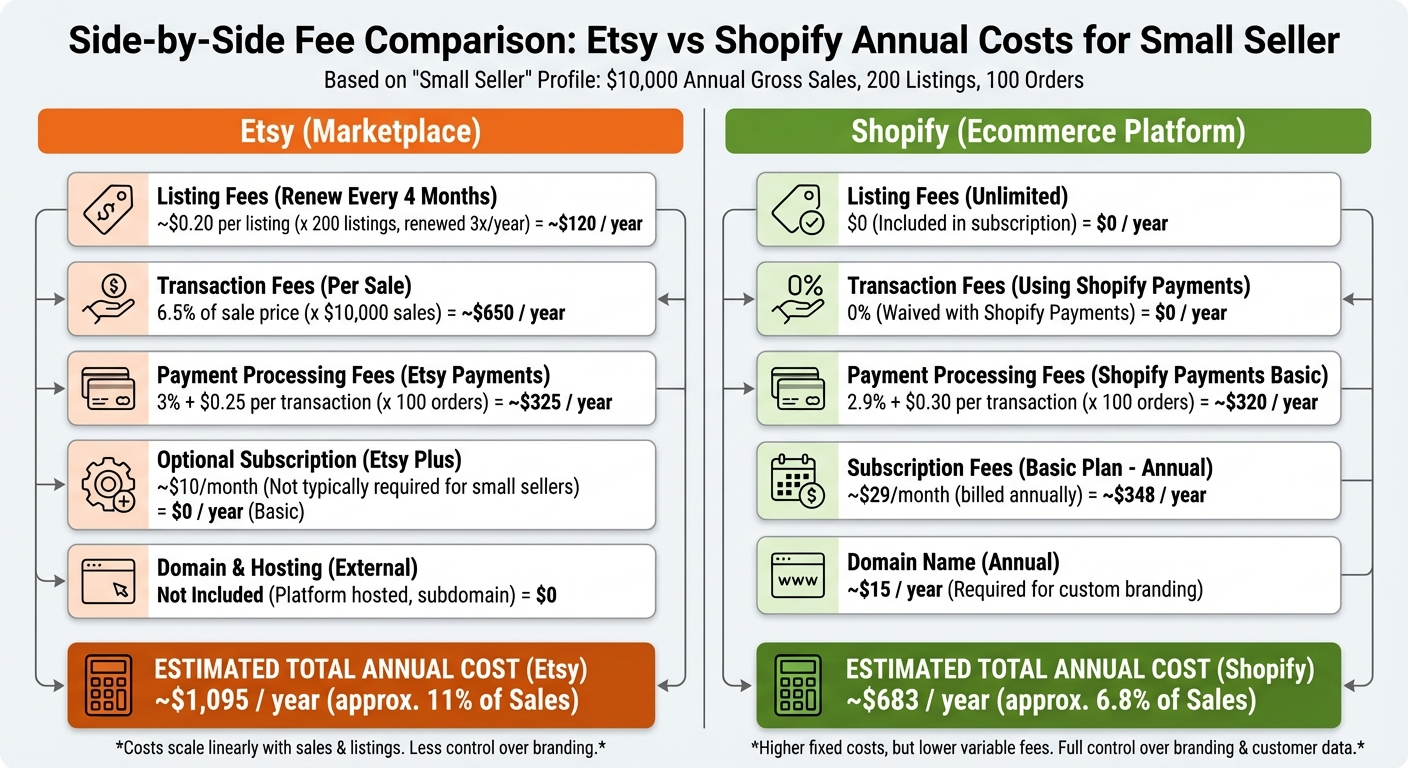
The more you sell, the more Shopify's flat-rate model saves you. This is exactly why many sellers start on Etsy and migrate to Shopify as they scale. Understanding how to price your handmade products with platform fees factored in is critical regardless of which platform you choose.
Ease of Use and Setup
Etsy Setup Experience
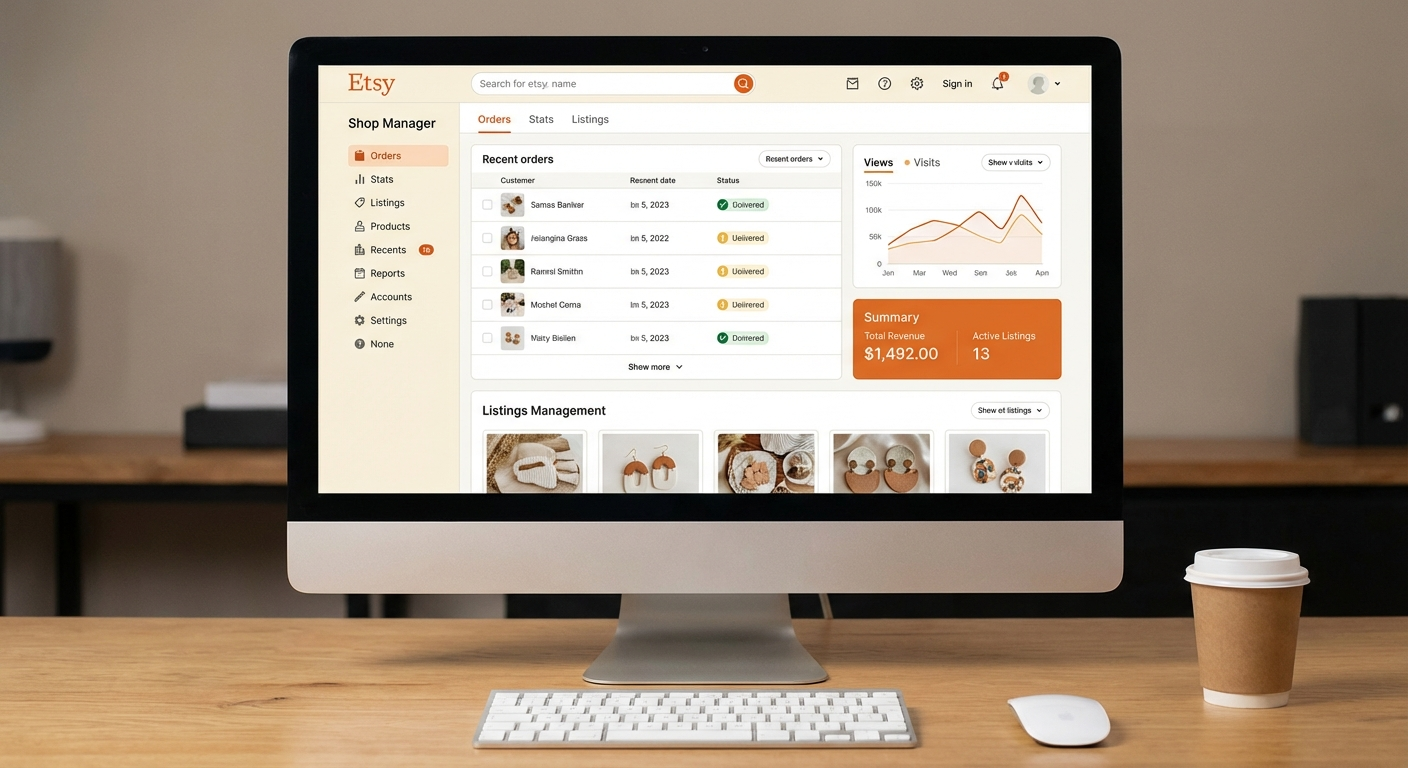
Etsy is designed to get you selling fast. The onboarding wizard walks you through shop preferences, your first listing, payment setup, and billing in under 30 minutes. There is no website to build, no domain to purchase, no hosting to configure.
The listing process is straightforward: upload photos, write a title and description, set your price, add tags, and publish. Etsy handles the checkout experience, payment processing, and buyer communication infrastructure.
Where Etsy shines for beginners:
- No technical skills required
- Guided setup flow with prompts
- Built-in payment processing
- Mobile app for managing orders on the go
- Instant access to the Etsy marketplace after publishing
Shopify Setup Experience
Shopify requires more upfront work but gives you more control. You will need to:
- Choose and customize a theme (or hire a developer)
- Set up your product catalog with collections
- Configure a domain name
- Set up payment providers
- Configure shipping rates and tax settings
- Install apps for features you need
- Create legal pages (privacy policy, terms of service, refund policy)
- Test the checkout flow before going live
Shopify's drag-and-drop editor has improved significantly with Online Store 2.0 and the newer Dawn-based themes. Most sellers can set up a functional store within a weekend without coding knowledge. That said, the polish and performance you get from a Shopify store is noticeably more professional than what Etsy allows.
Where Shopify shines for setup:
- Full control over every aspect of your store
- Professional, branded storefront from day one
- 100+ free and premium themes
- App ecosystem with 8,000+ integrations
- Built-in blogging and content management
Design, Branding, and Customization
Etsy's Branding Limitations
On Etsy, your shop exists within the Etsy ecosystem. You can customize your:
- Shop banner and icon
- About section and shop story
- Listing photos and descriptions
- Shop sections (categories)
That is about it. Every Etsy shop shares the same basic layout, the same checkout flow, and the same navigation structure. Your brand lives within Etsy's brand. Buyers often remember they "bought it on Etsy" rather than remembering your shop name.
This is not necessarily a dealbreaker. Many seven-figure Etsy sellers thrive within these constraints because the marketplace traffic compensates for the branding limitations. But if brand recognition is a priority, you will feel the ceiling quickly.
Shopify's Customization Power
Shopify gives you a blank canvas. You control:
- Full website design through themes and custom code
- Your own domain name (yourbrand.com)
- Custom checkout experience (on Shopify Plus)
- Navigation structure and page layouts
- Email design and marketing automation
- Customer account portals
- Blog design and content strategy
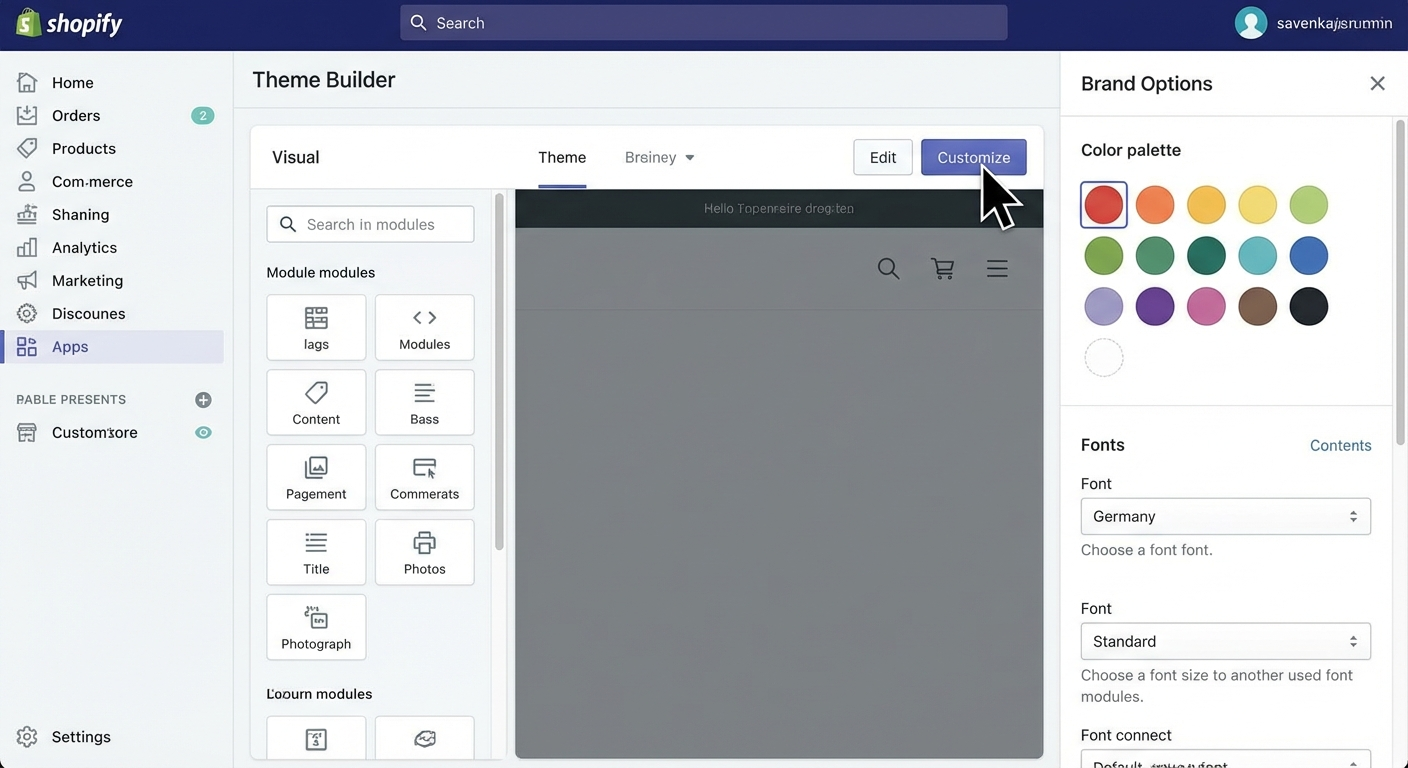
The Shopify Theme Store offers over 100 themes, many of them free. Premium themes from developers like Out of the Sandbox and Archetype run $180–$380 and deliver near-custom-build quality. For sellers who want complete control, Shopify's Liquid templating language and the newer Hydrogen framework allow full custom development.
Side-by-side walkthrough: Etsy shop customization vs Shopify theme editor
Traffic, Marketing, and SEO
This section is where the Etsy vs Shopify decision gets most interesting — and where most advice online gets it wrong.
Etsy's Built-in Traffic Advantage
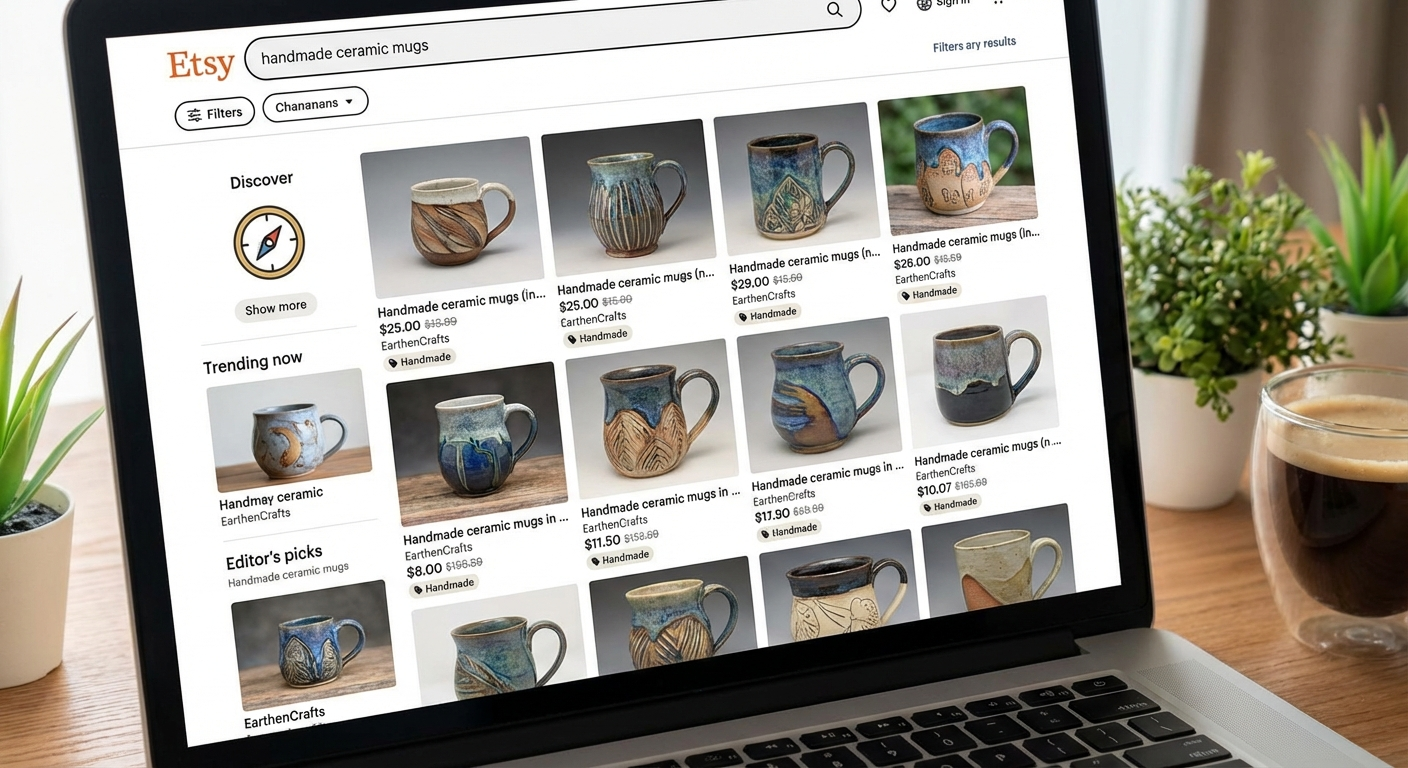
Etsy's biggest selling point is its marketplace traffic. Over 90 million active buyers search Etsy regularly, and the platform spends heavily on Google Shopping ads, social media advertising, and brand campaigns that drive shoppers to the marketplace.
When you list a product on Etsy, it immediately becomes searchable by millions of buyers. You do not need to run ads, build an email list, or create content to get your first views. Etsy's search algorithm considers:
- Listing quality score (photos, description completeness, attributes)
- Keyword relevance (title, tags, categories, attributes)
- Recency (newer and renewed listings get a temporary boost)
- Shop history (reviews, order completion rate, response time)
- Conversion rate (listings that sell well rank higher)
For new sellers, this built-in traffic is invaluable. If your listings are well-optimized, you can start getting views within days of opening your shop. Our guide to the best Etsy SEO tools covers the platforms that help you optimize for Etsy's search algorithm specifically.
Shopify's SEO and Marketing Control
Shopify gives you zero built-in traffic but far more tools to build sustainable, long-term traffic sources:
SEO advantages on Shopify:
- Custom URL structures (yourbrand.com/products/product-name)
- Full control over title tags, meta descriptions, and alt text
- Built-in blogging for content marketing
- Automatic sitemap generation
- 301 redirect management
- Canonical URL control
- Structured data support through apps
Marketing advantages on Shopify:
- Full customer data ownership (email addresses, purchase history)
- Built-in email marketing (Shopify Email)
- Abandoned cart recovery
- Discount code creation and management
- Integration with every major ad platform
- Loyalty programs and referral tools through apps
The fundamental difference is ownership. On Etsy, the platform owns the customer relationship. You cannot email past buyers directly, you cannot retarget them with ads (unless you use Etsy's own tools), and you cannot build a direct relationship outside the marketplace.
On Shopify, every customer who buys from you is your customer. You own their email, their purchase data, and their consent to be marketed to. This is enormously valuable for long-term business building.
Google SEO: A Nuanced Comparison
Etsy's domain authority (DA 90+) means individual Etsy listings can rank in Google search results, sometimes faster than a new Shopify store's product pages. However, you are competing with every other Etsy seller for those Google rankings, and you have minimal control over the on-page SEO elements.
Shopify stores start with a DA of essentially zero, but you own the domain and can build authority over time through content marketing, backlinks, and a strong technical SEO foundation. After 12–18 months of consistent effort, a well-run Shopify blog can become a significant traffic driver.
Building daily habits for Etsy shop growth that include SEO maintenance, social media posting, and email marketing is essential regardless of which platform you choose.
Scalability and Growth Features
Where Etsy Hits a Ceiling
Etsy works well up to a point. Here are the scaling limitations that eventually push sellers toward Shopify:
- Fee escalation. As sales grow, the 6.5% transaction fee becomes a significant cost center. A shop doing $10,000/month in sales loses $650/month to Etsy transaction fees alone.
- Limited product organization. Etsy supports shop sections, but there are no true collections, filtering, or catalog management tools comparable to Shopify.
- No subscription or wholesale options. Etsy does not natively support recurring billing, subscription boxes, or wholesale pricing tiers.
- Algorithm dependence. An Etsy algorithm change can cut your traffic overnight. You have no control over this.
- Customer data restrictions. You cannot build email marketing funnels with Etsy buyer data outside of Etsy's platform.
- Brand dilution. Etsy shows competitor products on your listing pages. You are always competing for attention, even on your own product pages.
Shopify's Growth Infrastructure
Shopify was built for scaling. Features that matter as you grow:
- Shopify Markets for international selling with localized currencies and languages
- Shopify POS for in-person sales at craft fairs, pop-ups, and retail
- Shopify Fulfillment Network for warehousing and shipping
- Shopify Capital for business loans based on sales data
- B2B and wholesale channels with custom pricing
- Subscription apps (Recharge, Bold Subscriptions) for recurring revenue
- Advanced analytics including cohort analysis and customer lifetime value
- Staff accounts for team management as you hire
- API access for custom integrations and automation
Product Types and Limitations
Both platforms handle physical products, digital downloads, and services. However:
Etsy restricts what you can sell. Everything must be handmade, vintage (20+ years old), or a craft supply. Reselling mass-manufactured products violates Etsy's terms and can result in shop suspension.
Shopify has no product restrictions (within legal bounds). You can sell physical goods, digital products, services, memberships, courses, software, and anything else you can imagine. This flexibility matters if your business evolves beyond handmade goods.
Who Should Use Etsy (And When)
Etsy is the right choice if you fit any of these profiles:
The New Seller
You have a product idea — handmade candles, digital planners, custom pet portraits — and you want to test market demand without investing in a full website. Etsy lets you validate your idea with minimal financial risk. List your products, see if people buy them, and iterate based on real customer feedback.
The Side Hustler
You are not ready to commit to a full e-commerce business. You want to earn extra income from your creative skills without the overhead of a monthly subscription, a custom website, and a marketing strategy. Etsy's pay-per-sale model means you only incur costs when you actually make money.
The Handmade or Vintage Specialist
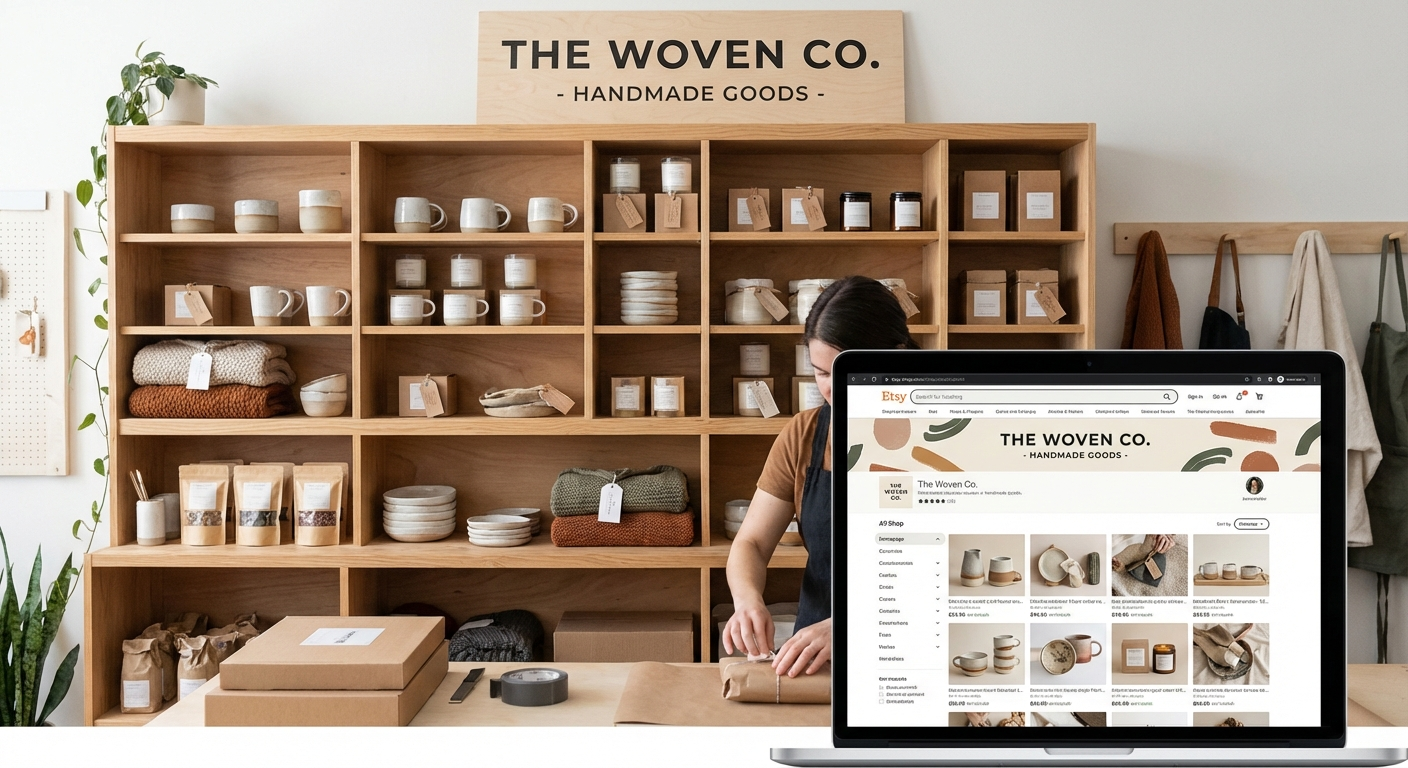
Your products are handmade, vintage, or craft supplies — the exact categories Etsy's audience shops for. Etsy's buyer base actively seeks out unique, artisan goods and is willing to pay a premium for them. No other marketplace concentrates this buyer intent as effectively.
The Digital Product Creator
Etsy's instant digital download system handles delivery automatically. If you sell printables, SVG files, Canva templates, or digital art, Etsy's infrastructure eliminates the need for a separate delivery system.
Who Should Use Shopify (And When)
Shopify is the right choice if you fit any of these profiles:
The Brand Builder
You want customers to remember your brand, not the marketplace. You have a logo, a visual identity, and a story that differentiates you. You want a yourbrand.com domain, custom packaging, and an end-to-end customer experience that reflects your values.
The Scaling Seller
You are already making consistent sales (on Etsy or elsewhere) and need more control over margins, customer data, and growth tools. You have proven product-market fit and are ready to invest in infrastructure that supports $5,000–$50,000+ per month in revenue.
The Multi-Channel Operator
You want to sell through your website, Instagram, Facebook, TikTok, Amazon, Walmart, and wholesale — all from one dashboard. Shopify's multi-channel architecture makes this manageable. Etsy is just one channel; Shopify can be the hub that connects them all.
The Content Marketer
You understand that blogging, email marketing, and SEO are long-term traffic strategies. You want to publish articles, build an email list, and create a content ecosystem that drives organic traffic for years. Shopify's built-in blog and app integrations support this fully.
Can You Use Both? The Multi-Channel Strategy
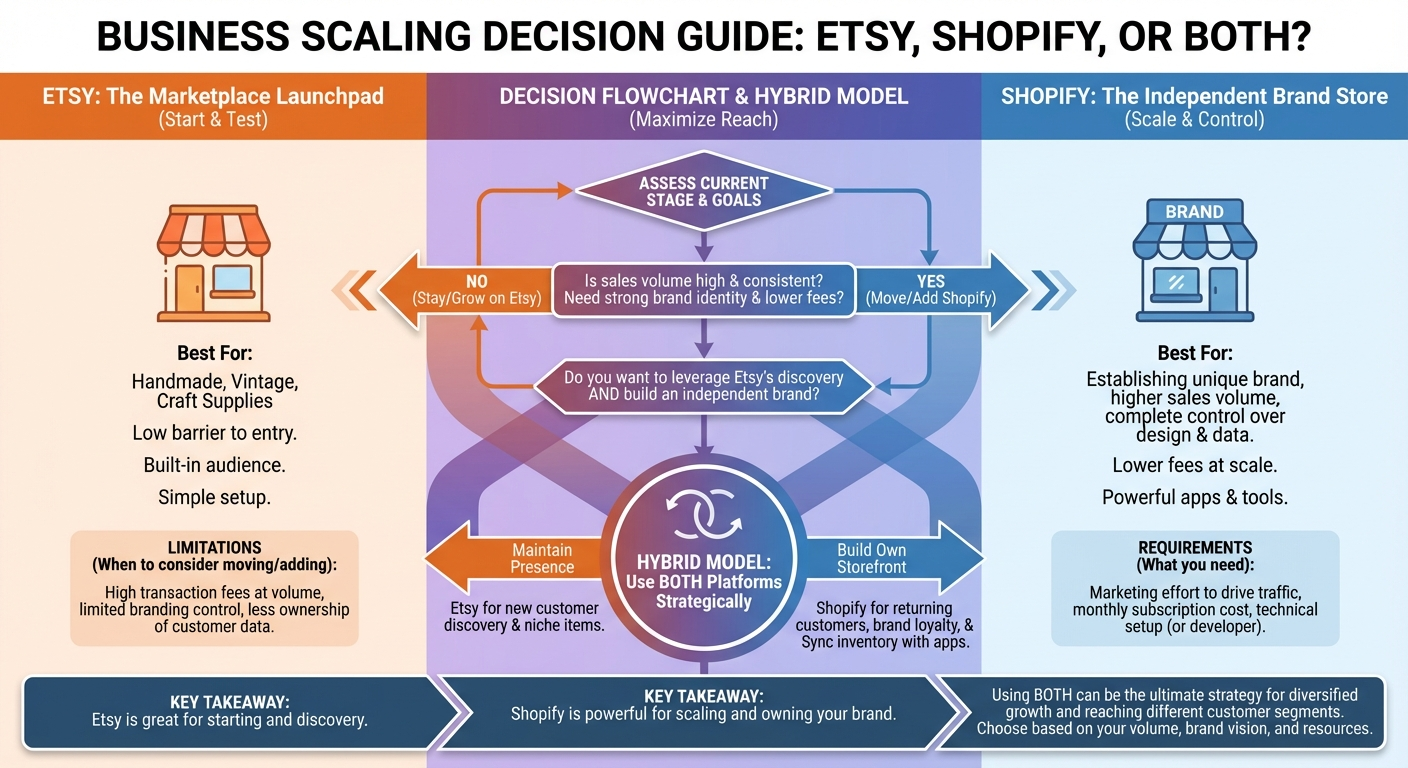
Yes — and for most growing sellers, this is the smartest approach.
Here is how a multi-channel Etsy + Shopify strategy works in practice:
Phase 1 — Validate on Etsy. Launch your products on Etsy to test demand. Use Etsy's marketplace traffic to generate your first 50–100 sales. Collect reviews, refine your offerings, and identify your best sellers.
Phase 2 — Build on Shopify. Once you have proven demand, launch a Shopify store with your best-performing products. Start building an email list, create content, and begin driving branded traffic.
Phase 3 — Optimize both channels. Keep your Etsy shop open as a discovery channel. Use Etsy to attract new customers who search the marketplace. Include a business card or insert in Etsy orders that directs buyers to your Shopify site for future purchases, exclusive products, or loyalty rewards.
Phase 4 — Expand beyond. Use Shopify as your central hub and add additional sales channels: Amazon Handmade, Instagram Shopping, TikTok Shop, wholesale accounts, and pop-up events through Shopify POS.
Tools for Multi-Channel Management
Several tools help you manage inventory, orders, and listings across both platforms:
- LitCommerce syncs products and inventory between Etsy and Shopify in real time
- Sellbrite (now owned by GoDaddy) connects Etsy, Shopify, Amazon, eBay, and Walmart
- Shopify's Marketplace Connect app manages listings across multiple marketplaces from the Shopify admin
- Printful and Printify handle print-on-demand fulfillment across both platforms simultaneously
Essential Tools and Resources for E-commerce Sellers
Whether you choose Etsy, Shopify, or both, these resources will help you build a more profitable online business.
eRank — Etsy SEO & Analytics
Best for: Etsy keyword research and listing optimization
eRank is the most comprehensive free Etsy SEO tool available. It provides keyword explorer, trend tracking, listing audits, and competitor analysis. The paid plans ($5.99–$11.99/month) unlock advanced features like bulk listing analysis and keyword lists.
Why sellers love it: The free tier alone gives you more SEO data than most paid alternatives.
Canva Pro — Design & Branding
Best for: Product mockups, social media graphics, and shop branding
Canva Pro ($12.99/month) gives you access to 100M+ stock photos, brand kits, background remover, and thousands of templates for product listings, social posts, and email headers. Essential for sellers without a graphic design background.
Why sellers love it: The Brand Kit feature keeps your visuals consistent across Etsy and Shopify.
E-Commerce Evolved by Tanner Larsson
Best for: Understanding e-commerce strategy beyond marketplace selling
This book covers the full spectrum of building an online retail business: traffic acquisition, conversion optimization, customer retention, and scaling. Particularly valuable for sellers transitioning from Etsy to Shopify or running both.
Why sellers love it: Actionable frameworks, not theory. Every chapter ends with implementation steps.
The $100 Startup by Chris Guillebeau
Best for: Entrepreneurs validating product ideas on a budget
Chris Guillebeau profiles 50 businesses launched for under $100. For Etsy sellers thinking about expanding to Shopify, this book provides the mindset and framework for growing a micro-business into a sustainable brand.
Why sellers love it: It validates the Etsy-first, Shopify-later approach with real case studies.
Klaviyo — Email Marketing
Best for: Email automation and customer retention for Shopify sellers
Klaviyo is the gold standard for e-commerce email marketing. It integrates natively with Shopify and offers pre-built flows for abandoned carts, post-purchase follow-ups, win-back campaigns, and product recommendations. Free for up to 250 contacts.
Why sellers love it: Shopify integration pulls in real purchase data for hyper-personalized email campaigns.
Building a StoryBrand by Donald Miller
Best for: Crafting a brand message that converts browsers to buyers
Donald Miller's framework helps you clarify your brand story so customers immediately understand what you sell and why it matters. Essential reading before building a Shopify storefront where brand messaging is entirely your responsibility.
Why sellers love it: The one-page StoryBrand script is a practical tool you can implement in a single afternoon.
Printful — Print-on-Demand Fulfillment
Best for: Sellers who want custom products without holding inventory
Printful integrates with both Etsy and Shopify, handling printing, packing, and shipping for over 340 product types. You design the products; Printful produces and ships them when orders come in. No upfront inventory costs.
Why sellers love it: Seamless integration with both platforms means you can run the same products on Etsy and Shopify simultaneously.
Frequently Asked Questions
Is Etsy or Shopify better for beginners?
Etsy is generally better for beginners because it requires no upfront monthly fee, provides built-in marketplace traffic, and handles hosting and payment infrastructure automatically. You can list your first product for just $0.20 and start selling immediately without building a website. Shopify offers more control but requires a monthly subscription and the ability to drive your own traffic.
Can I sell on both Etsy and Shopify at the same time?
Yes, many successful sellers use both platforms simultaneously. Etsy serves as a discovery channel where new customers find your products through marketplace search, while Shopify acts as your branded home base with higher margins and full customer data ownership. Tools like Shopify's Marketplace Connect app and third-party services like LitCommerce make multi-channel selling manageable.
What are the total fees on Etsy vs Shopify in 2026?
On Etsy, you pay a $0.20 listing fee per item, a 6.5% transaction fee, and a 3% + $0.25 payment processing fee — totaling roughly 10–12% per sale. On Shopify Basic ($39/month), you pay 2.9% + $0.30 per transaction with no additional platform commission. For sellers doing over $500 per month in revenue, Shopify often works out cheaper on a per-order basis.
Does Etsy or Shopify have better SEO?
Shopify gives you more SEO control with custom URLs, full meta tag editing, blog functionality, and the ability to build topical authority on your own domain. Etsy benefits from high domain authority (DA 90+) which can help individual listings rank in Google faster. The best strategy is using Etsy for marketplace-specific search traffic and Shopify for building long-term organic search presence on your own brand domain.
When should I move from Etsy to Shopify?
Consider moving to Shopify (or adding it alongside Etsy) when you consistently earn over $1,000 per month on Etsy, when you want to build a recognizable brand beyond the Etsy marketplace, when you need advanced features like subscriptions or wholesale pricing, or when Etsy fees are cutting significantly into your margins. Most consultants recommend keeping your Etsy shop open while building your Shopify presence.
Is Shopify worth the monthly cost if I am just starting out?
For most brand-new sellers, Shopify is not worth the monthly cost. The $39/month Basic plan means you need to generate enough sales to cover that fixed cost before earning a profit. Etsy lets you start with near-zero upfront costs and only charges fees when you actually make a sale. Once you have a proven product and steady revenue, Shopify becomes the more cost-effective and scalable option.
Sources and Methodology
This comparison is based on direct experience consulting with e-commerce sellers, official platform documentation, and the following sources:
- Etsy Seller Handbook — Official Etsy documentation on fees, policies, and best practices. etsy.com/seller-handbook
- Shopify Pricing Page — Current Shopify plan pricing and feature comparison. shopify.com/pricing
- Etsy Q4 2025 Earnings Report — Active buyer metrics, gross merchandise sales, and marketplace growth data. investors.etsy.com
- Marketplace Pulse: Etsy Seller Data (2025) — Independent analysis of Etsy marketplace trends, seller counts, and category performance. marketplacepulse.com
- Shopify Commerce Trends Report 2026 — Shopify's annual report on e-commerce trends, consumer behavior, and seller growth patterns. shopify.com/research
- BigCommerce: Etsy vs Shopify Comparison — Third-party platform comparison with fee calculations and feature analysis. bigcommerce.com
Fee calculations are based on published platform rates as of March 2026. Individual results vary based on product category, pricing strategy, and sales volume.
About the Author
Ashley Park is an e-commerce business consultant who has helped over 300 small businesses choose and optimize their online sales platforms. With 10 years of experience running shops on both Etsy and Shopify, Ashley specializes in helping creative entrepreneurs match their tech stack to their growth stage. She has been featured in Entrepreneur Magazine and The Balance SMB, and currently advises early-stage sellers through her consulting practice. When she is not auditing Shopify themes or optimizing Etsy listings, Ashley mentors women-owned businesses through SCORE.
Have questions about choosing between Etsy and Shopify? Reach out through our contact page.